1 minute from Toyonaka Station
Natural fullness with your own fat.
OsakaWing Fat Grafting
Your own fat is purified, finely processed, and injected little by little into the cheeks, temples, and under the eyes. Where to reduce and where to add are designed within the same face — the "restrained beauty" Wing clinic values.
Wing clinicToyonaka
Booking & Inquiries 06-6318-8774 Call
[Hours] 10:00-20:00 / Last entry 19:00
Adding volume,
and making it last.
Fat grafting is a medical procedure in which your own fat is purified and moved to areas of the face that lack volume.
Fat injection is not a treatment in which everything injected stays. Only fat that connects to blood flow from the surrounding tissue remains.
That is why Wing clinic purifies the fat, breaks it into fine particles, and injects it little by little in separate layers. What we aim for is a change where“you can’t tell where anything was done, yet the whole face looks refined”. Rather than injecting too much at once, we work backward from the result 3 months later to decide the amount.
Contents
Tap to jump to a section
CheckWho facial fat grafting is suited to
- Your cheeks are hollow and you look tired
- Your temples are hollow and your face looks angular
- Hollows under your eyes or a mid-cheek groove make you look older
- Your forehead is flat and lacks roundness in profile
- You’d rather use your own tissue than keep repeating hyaluronic acid
- You’re considering facial liposuction but worry about looking gaunt
If even one of these applies, your own fat may be able to restore natural fullness to hollow areas.
However, it is not the best treatment for everyone. The first step is to determine whether it suits you.
At your examination, we check whether hollows are caused by volume loss, sagging, or bone structure, and make recommendations that may include combining hyaluronic acid, thread lifts, or liposuction.
SUITABLEWell suited to
- People who want to naturally fill hollows or gauntness in the face, such as the cheeks, temples, and under the eyes
- People who want to use their own tissue rather than a foreign substance
- People who want to refine a wide area with the long term in mind
- People who can cooperate with not smoking before and after treatment
CONSIDERNeeds careful consideration
- People who cannot stop smoking (see "Please stop smoking" for why)
- People whose hollows are mainly caused by sagging or bone structure (a thread lift or other treatment may take priority)
- People who are pregnant or breastfeeding, take anticoagulants, or have serious chronic illness cannot have this treatment (risks and how we handle them)
- After surgery 1 to 2 weeks or so: those for whom it is hard to set aside a period with swelling and bruising
MechanismHow fat grafting works
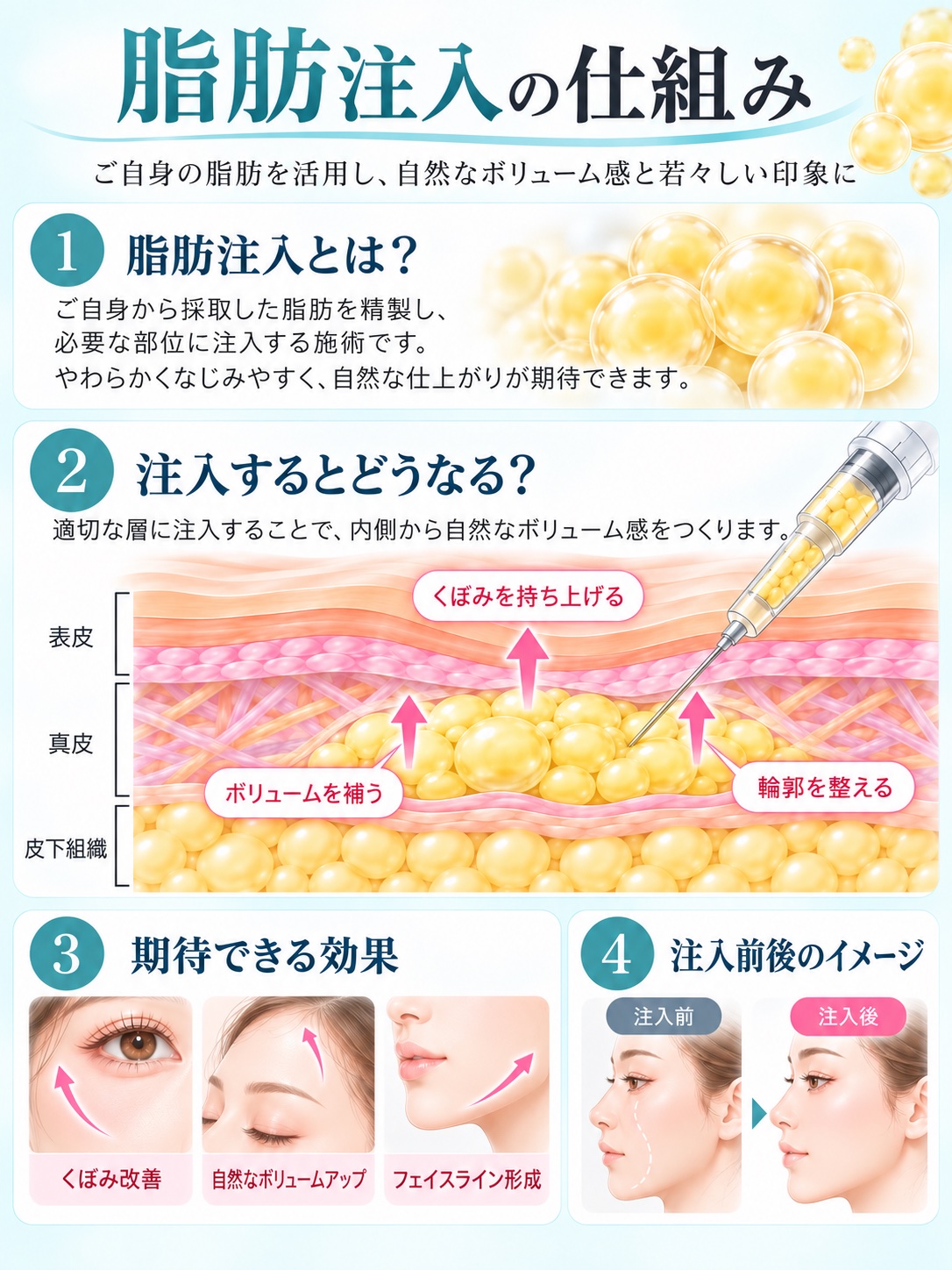
Fat is harvested from the thighs with a thin tube (cannula), purified, and transferred little by little to areas of the face that lack volume. Because only your own tissue is used, there is little concern about allergies to products, and fat that remains stays in place (it is affected by aging and weight changes).
The result depends on "what is injected" and "how it is injected." We purify the harvested fat by centrifugation (CRF), break it down finely with LipoCube Nano, and inject it little by little in separate layers with a blunt-tipped cannula (purification and processing).
Only the portion of injected fat that connects to blood vessels from the surrounding tissue remains; the rest is absorbed over a few weeks to 3 months. The proportion that remains varies with the area, constitution, and smoking, so we inject allowing for absorption and evaluate after 3 months. If it is not enough, you can consult us about re-injection (additional fee).
The fat grafting process
 STEP 01
- Design and marking
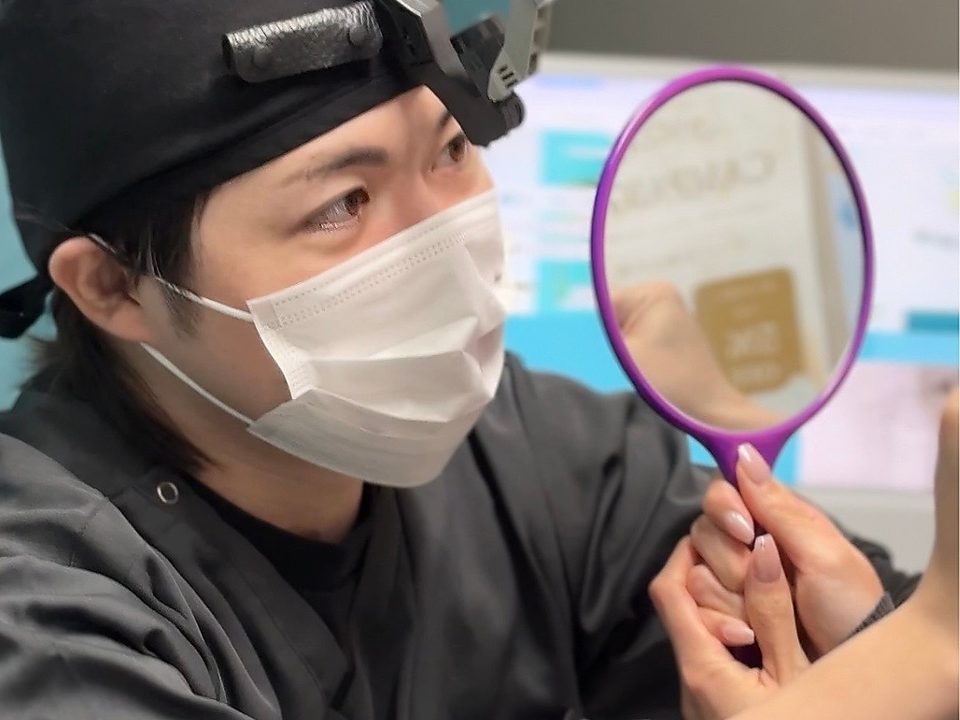
Looking in a mirror together, we confirm where and how much to inject. We decide the areas and amounts to inject and the area of the thigh to harvest from, and mark them.
 STEP 02
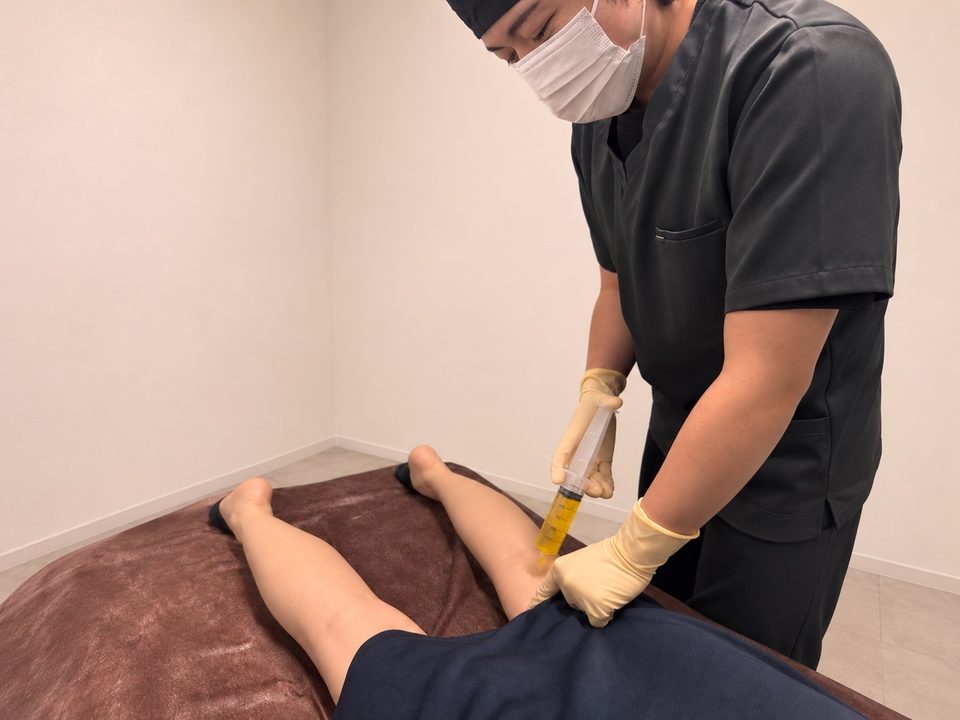
- Anesthesia
Nitrous oxide sedation eases your nerves, then IV sedation puts you in a sleep-like state. We proceed while monitoring your ECG and blood oxygen.
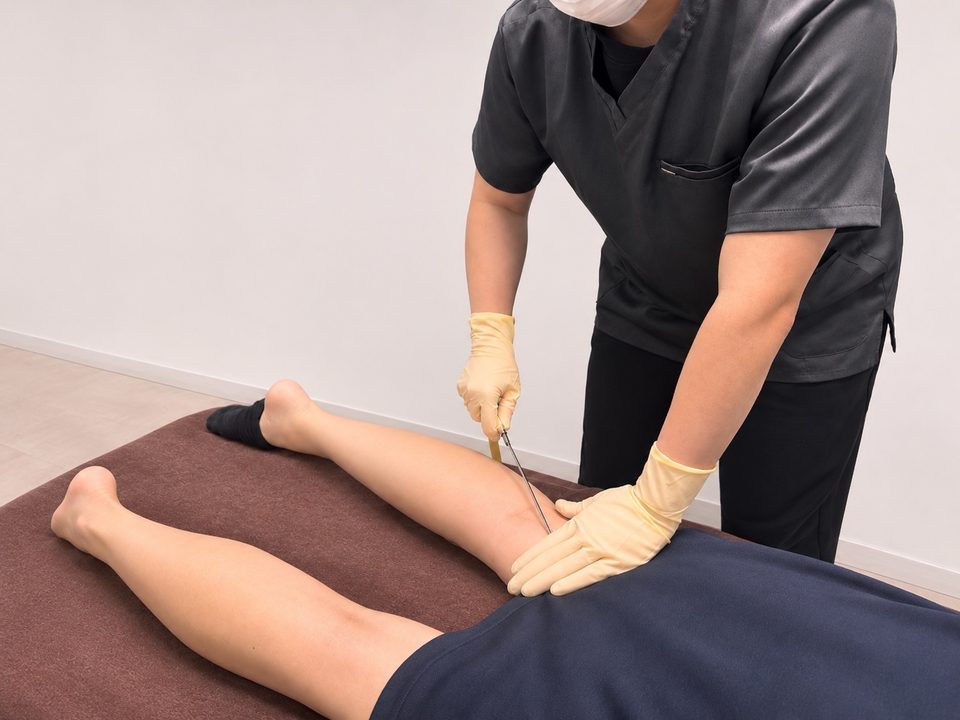 STEP 03
- Harvesting
Only the amount of fat needed is harvested with a thin cannula through openings of a few millimeters in the thigh. The area harvested follows the marking made in advance.
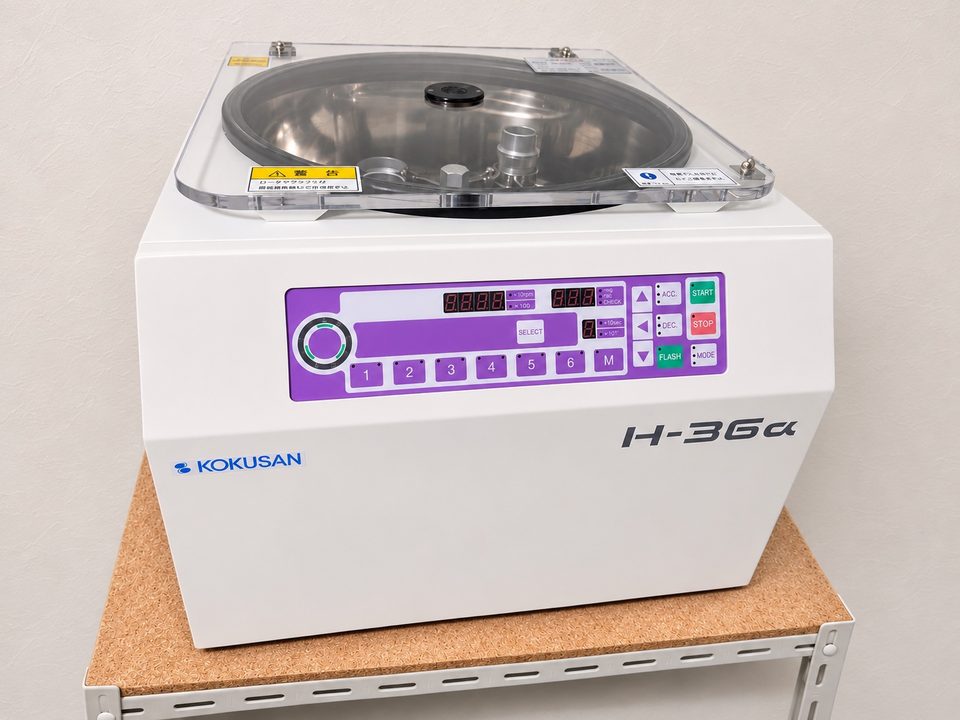 STEP 04
- Purification and processing
Centrifugation removes anesthetic fluid, blood, and oil (CRF), then the fat is passed through LipoCube Nano to even out the particles and processed into microfat or nanofat to suit each area.
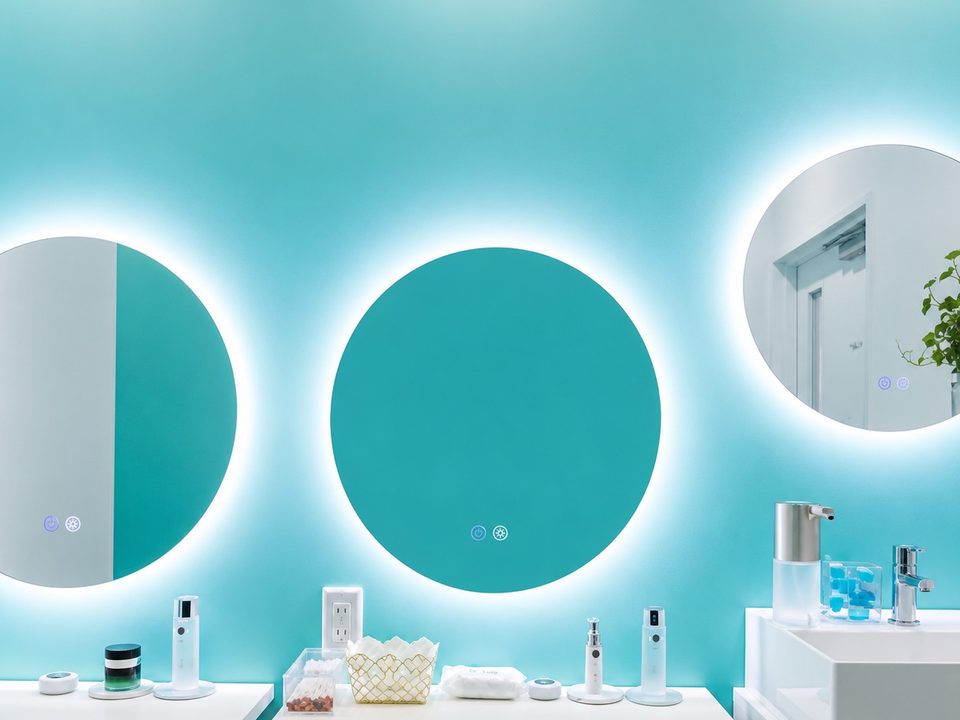
 STEP 05
- Injection
Using a thin, blunt-tipped cannula, fat is injected little by little in separate layers following the marking. The amount is adjusted while checking the balance of the whole face.
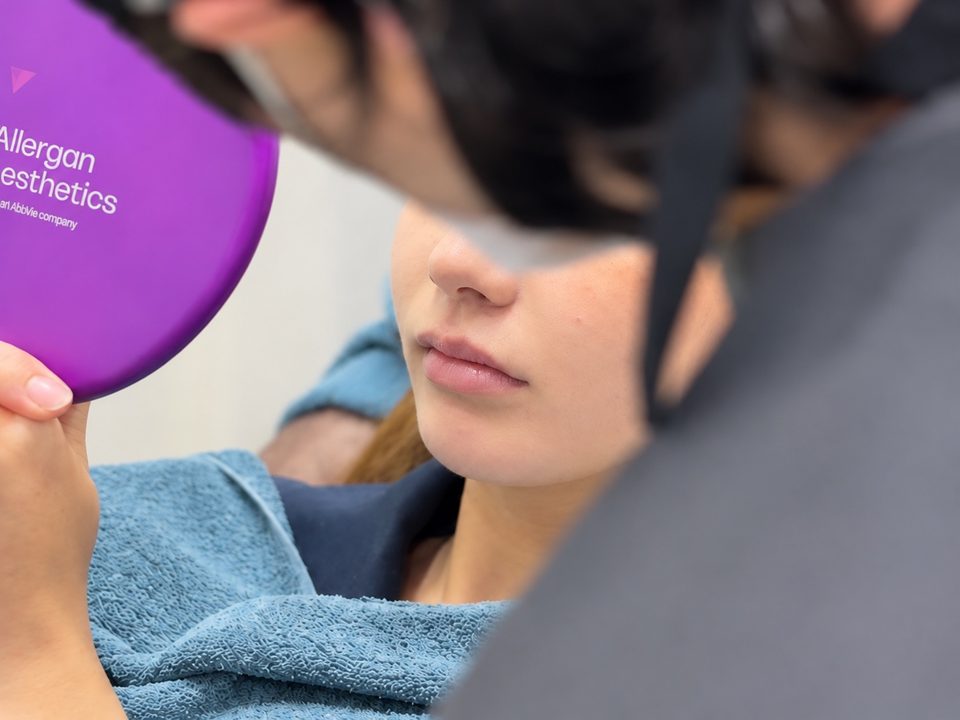
 STEP 06
- Checking the result and post-operative instructions
Once you wake from the anesthesia, we check the result and left-right balance together in a mirror. We explain the course of downtime, care for the harvest site, and precautions for daily life.
PreparationPurification and processing— CRF and LipoCube Nano
Rather than injecting harvested fat as is, we remove unwanted components by centrifugation (CRF) and break it down to even out the particles (LipoCube Nano) before injecting. Refining the "content" and "particle size" of the fat helps it integrate and makes lumps less likely. We are a medical institution certified by the CRF association, and CRF is standard for every case.
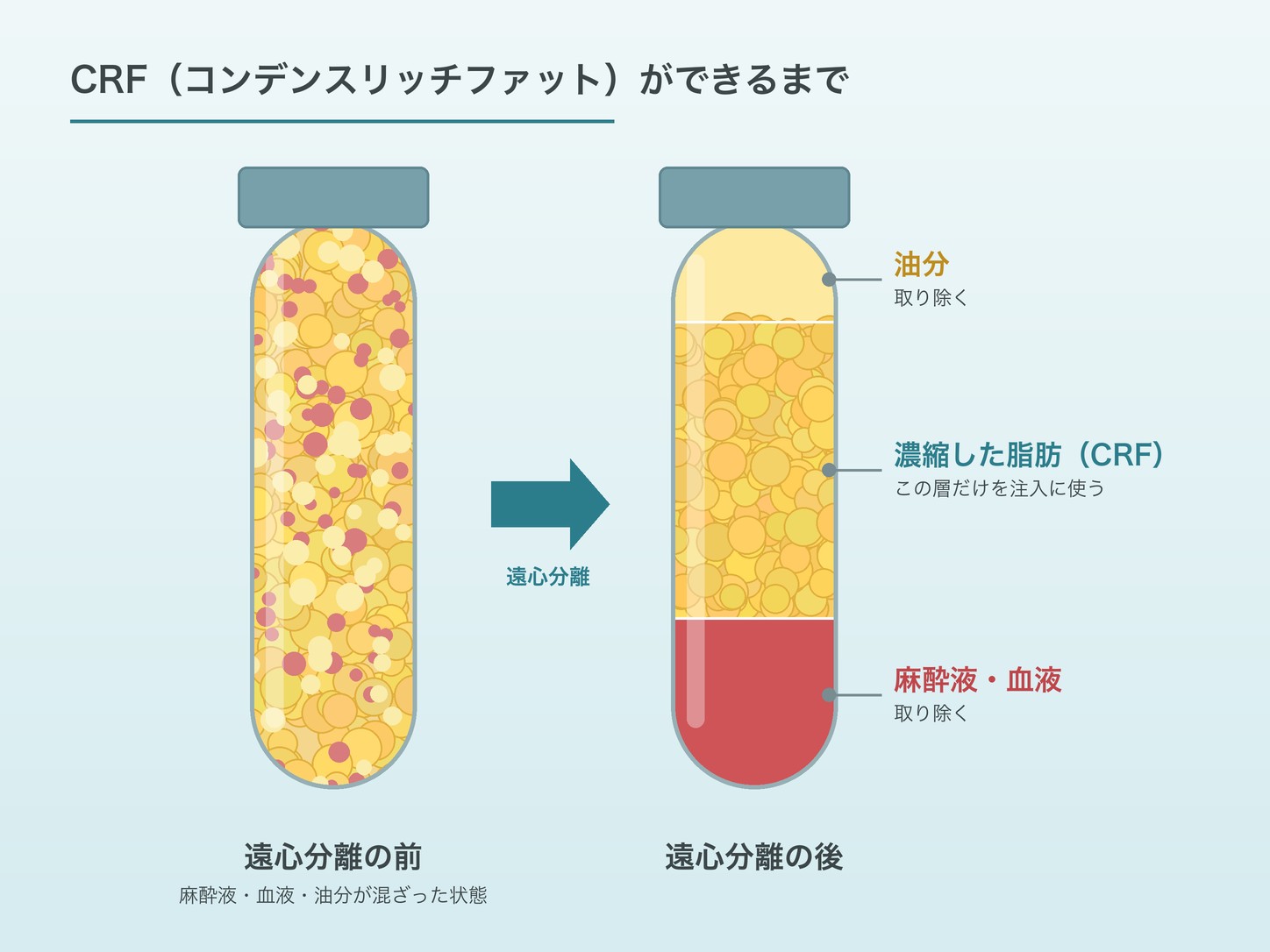
Purified before injectionCONDENSE RICH FAT
Freshly harvested fat is mixed with anesthetic fluid, water, blood, and oil released from broken cells. Anesthetic fluid and water are absorbed within days, making the "amount injected" appear larger than it is, and oil causes inflammation, oil cysts, and lumps.
CRF is a purification method that uses centrifugation to remove the oil that floats to the top and the anesthetic fluid and blood that sink to the bottom, leaving only the fat layer. We make it standard to keep the relationship between the amount injected and the amount that remains honest.
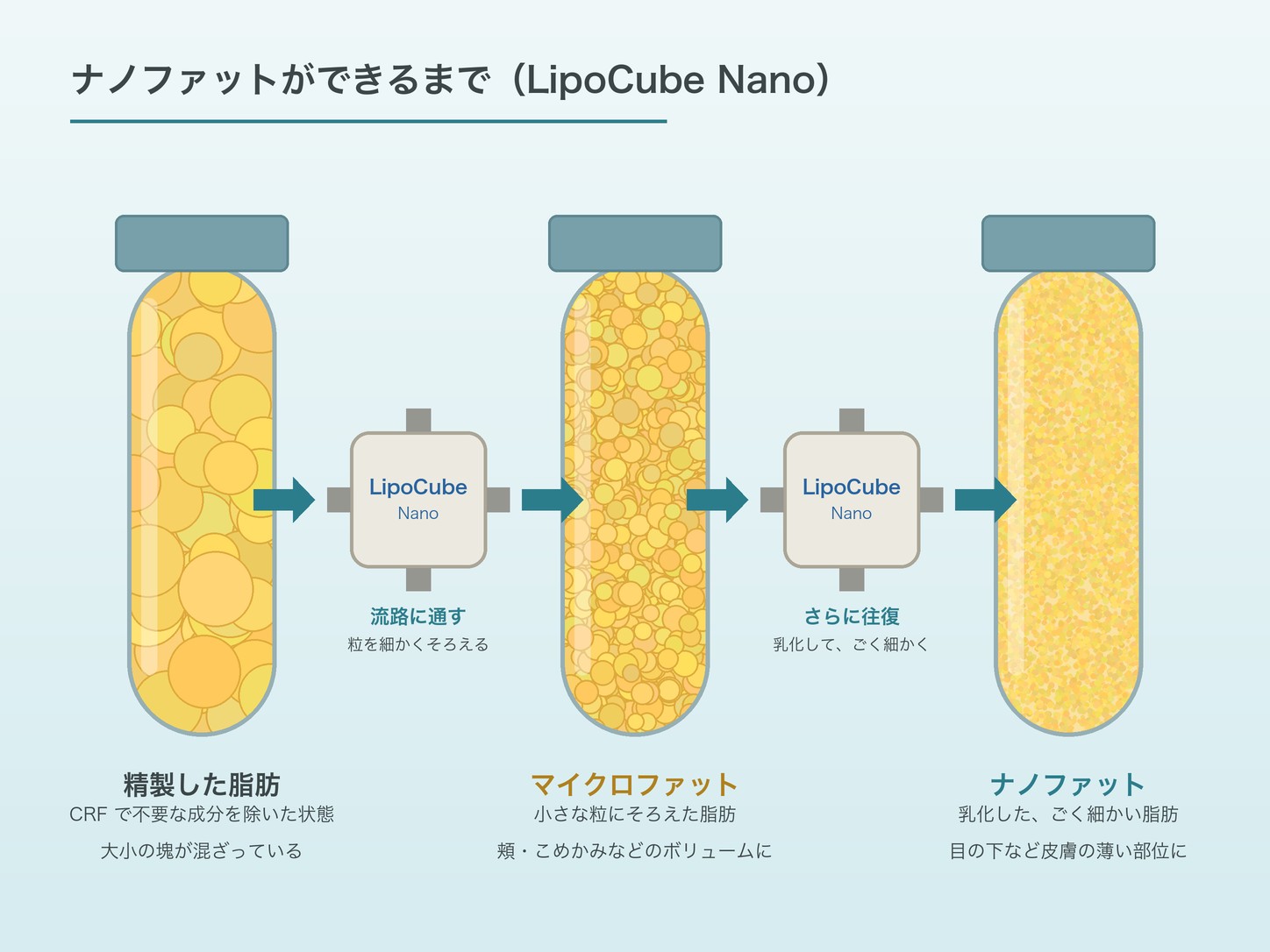
Finely processed before injectionLIPOCUBE NANO
Injected fat can survive only in the surface portion that receives nutrients from the surrounding tissue. If injected as large lumps, nutrients do not reach the center, and fat that cannot survive causes oil cysts, lumps, and calcification.
So we pass the purified fat through LipoCube Nano (single-use, closed system) to even out the particle size before injection. The smaller the particles, the more easily they contact the surrounding tissue, making them more likely to take and lowering the risk of lumps.
For areas where volume is added, such as the cheeks, temples, and forehead, we use Microfat, which keeps the structure of fat cells intact. For thin-skinned areas such as under the eyes, we use even more finely emulsified Nanofat (option: 150,000 yen) in the shallow layer to smooth the surface.
Micro vs NanoMicrofat vs.nanofat
| Comparison | Microfat | Nanofat (recommended) |
|---|---|---|
| Particle size | ○ Evened into small particles | ◎ Emulsified, even finer |
| How easily it takes | ○ | ◎ Small particles that nutrients from the surroundings reach easily |
| Risk of lumps | ○ Reduced | ◎ Reduced even further |
| Smoothness of the result | ○ | ◎ Irregularities are unlikely |
| Areas with thin skin, such as under the eyes | △ Irregularities may appear | ◎ Well suited |
| Prices | Included in fat harvesting and CRF preparation | Nanofat processing 150,000 yen (per session) |
* Results and how well the fat takes vary by individual. The doctor will recommend which to use after examining the area and skin thickness.
Information on unapproved medical devices (LipoCube Nano)
LipoCube Nano, which we use to process fat (manufacturer: StemC Biyoteknoloji, Türkiye),
is a medical device that has not been approved in Japan under the Act on Pharmaceuticals and Medical Devices.
- How it is obtained
- It is obtained through personal import at the doctor’s discretion.
- Approved medical devices in Japan
- There are no approved medical devices in Japan with the same performance.
AreasSix areas that can be injected
The numbers in the illustration match the numbers in the list.
We will recommend where and how much to inject based on the balance of your whole face.
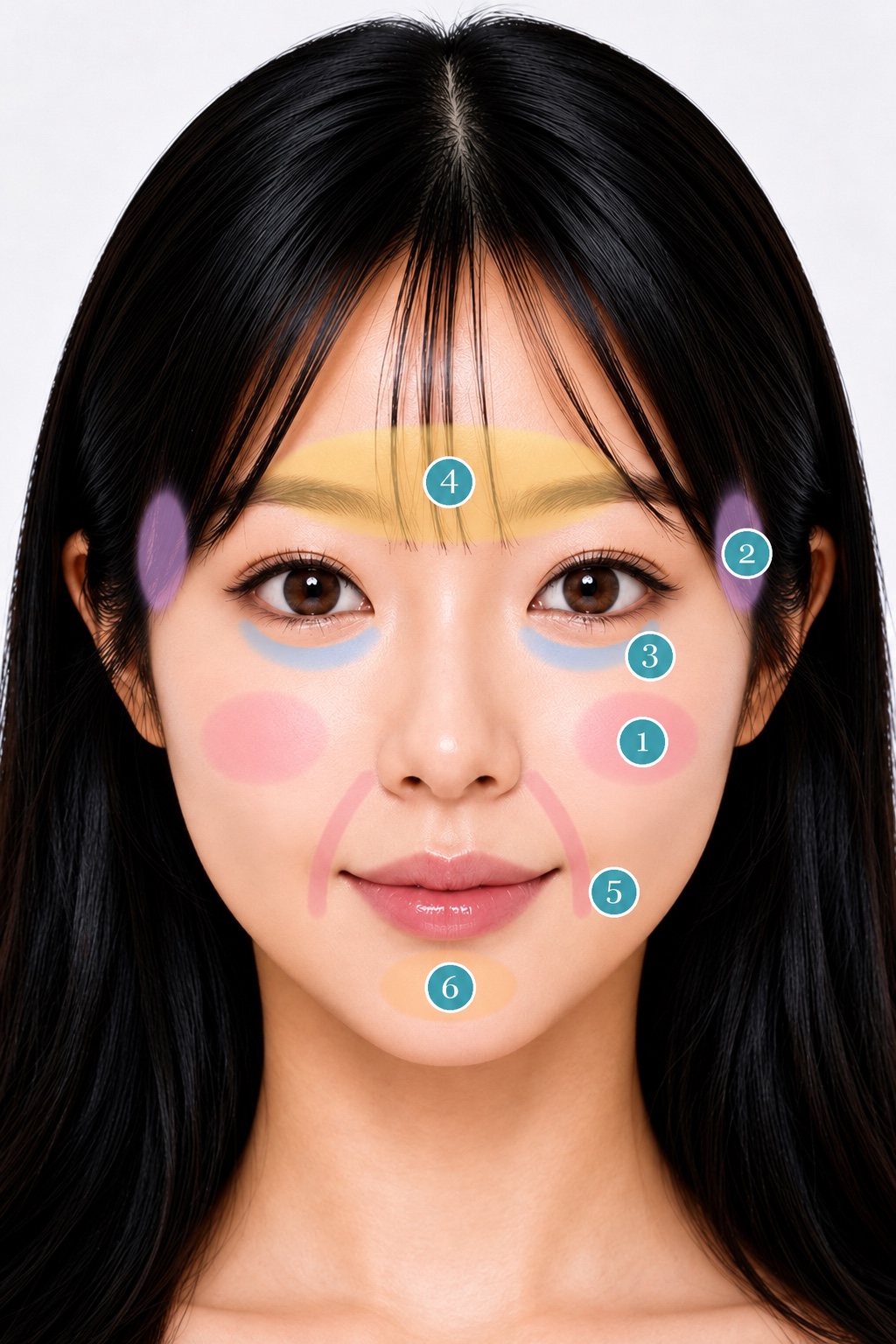
- 1
CheeksCheek
Softens a gaunt, tired look for fuller cheeks.
- 2
TemplesTemple
Fills hollows and smooths an angular contour.
- 3
Under the eyes to the mid-cheek grooveUnder Eye
Softens hollows and shadows, lightening a tired or aged look. Because the skin is thin, we inject with particular care.
Recommended: nanofat processing (option)
- 4
ForeheadForehead
Adds roundness to a flat forehead and softens the profile.
- 5
Nasolabial foldsNasolabial
Softens shadows around the mouth for a youthful look. If sagging is the main cause, we may also consider a thread lift.
- 6
ChinChin
Brings the chin slightly forward to balance the profile.
- 7
Other areasOther
Areas other than those above may also be treatable after an examination. If there is an area you would like treated, please ask during your consultation.
* In areas where the skin is extremely thin or there are many blood vessels, we may inject less or suggest a different method.
For a guide to swelling, see the downtime timeline.
Five PrinciplesFive things we protect when designing fat grafting
- 01
- Purify first
CRF removes oil and broken cells, and LipoCube Nano breaks the fat down finely before injection.
- 02
- Never inject in clumps
Thin layers are built up little by little, injecting only as much as the surrounding blood supply can reach.
- 03
- Don’t overinject
We work back from your face at 3 months. If there isn’t enough, we choose to add more later.
- 04
- Inject slowly
The more blood vessels in an area, the lower the pressure and the slower we inject, reducing the risk of injection into a blood vessel.
- 05
- Consider the whole face
Where to reduce and where to add are planned in a single blueprint.
ComparisonFat grafting vs.hyaluronic acid
Many people are unsure whether to choose their own fat or hyaluronic acid. Each suits different situations.
| Comparison | Fat grafting | Hyaluronic Acid Fillers |
|---|---|---|
| Material | Your own fat Harvested from the thighs and purified | Hyaluronic acid filler |
| Best for | Volume over a wide area Adding volume across surfaces such as the cheeks and temples | Fine adjustments to shape in small areas Such as under-eye tear bags and lips |
| Longevity | Long-lasting Fat that takes becomes your own tissue (affected by weight and aging) | A few months to 1.5 years Absorbed gradually |
| Sessions | Usually 1 Re-injection if there isn’t enough | Repeated regularly According to absorption |
| Downtime | 1–3 months Including the harvest site | A few days |
| Anesthesia | Nitrous oxide + IV sedation Required | Local anesthesia Numbing cream, etc. |
| Best for | Long-lasting results No foreign substances | Trying it once first Getting back to normal quickly |
For those who want to try once first or keep downtime short: hyaluronic acid fillers
With no harvesting, downtime is a few days, and it can be done under local anesthesia. It is absorbed over several months to 1.5 years, so it needs to be repeated, but it is also suited to fine-tuning the shape after fat injection.
*Results and duration vary from person to person.
CombinationTreatments designed in combination
The face is refined by combining "reducing, lifting, and adding." Rather than trying to solve everything with fat grafting, we choose methods according to the cause.
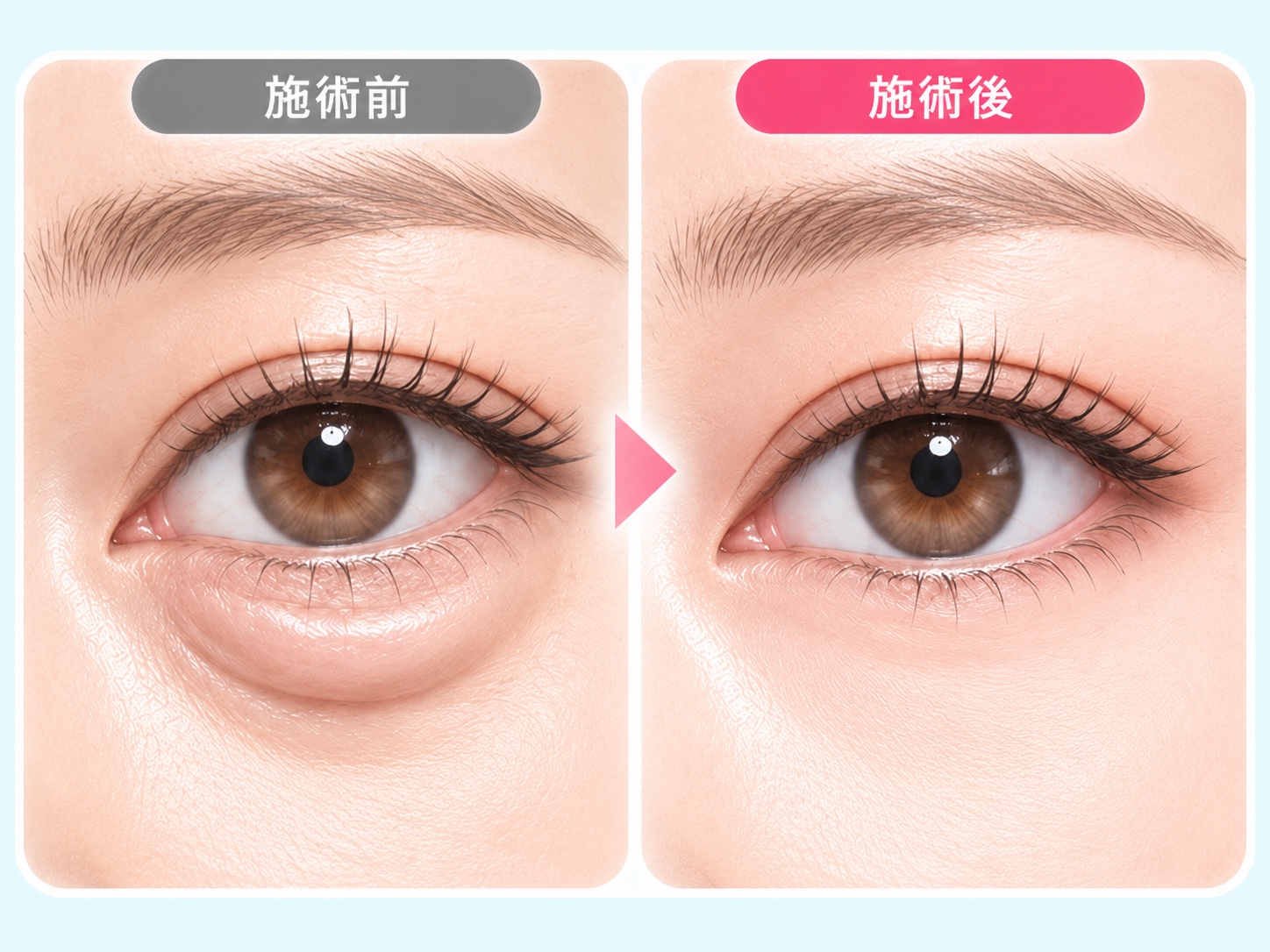 UNDER EYE · SET
Under-eye bag removalUNDER EYE
The bulge under the eyes (orbital fat) is removed, and fat is added to the hollow below it (tear trough and mid-cheek groove). Refining both on the same day prevents "the bags are gone but the shadow remains."
* Fat removed from under the eyes is not used for injection; fat is harvested separately from the thighs.
Under-eye bag removal treatment page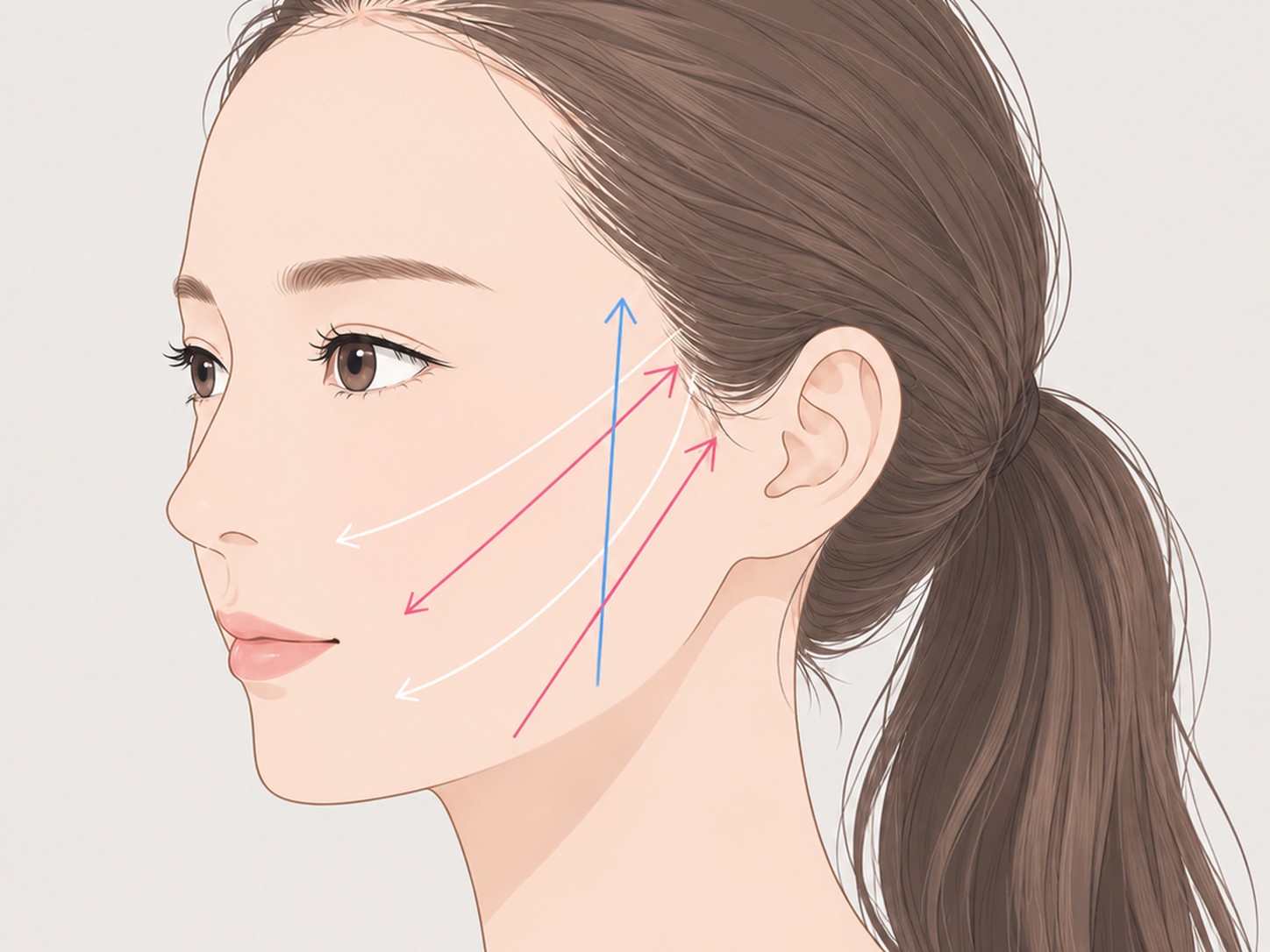 THREAD LIFT · LIFT
Thread liftTHREAD LIFT
If nasolabial folds or a mid-cheek groove are caused by sagging, simply adding fat can add weight. Sagging is lifted with threads, and hollows are filled with fat. By addressing each cause separately, we aim for a natural result.
Thread Lift treatment page* Whether combinations are possible, which ones, and the prices are proposed during your consultation after an examination. The same combination is not suitable for everyone.
AnesthesiaAbout anesthesia
Because fat grafting involves harvesting fat and injecting it into the face in one session, combining nitrous oxide sedation and IV sedation is required (it is not optional). Nitrous oxide first eases your nerves, then IV sedation puts you in a sleep-like state for everything from harvesting to injection.
-
01
- Nitrous oxide sedation (required)
-
You inhale an odorless gas that eases tension and anxiety. It is used before the IV sedation line is placed, reducing pain and tension from the needle.
- Takes effect 5 to 10 minutes after inhalation
- You can move smoothly from a conscious state to IV sedation
- The effect wears off within a few minutes once you stop inhaling
- If you have severe asthma, please consult us
-
02
- IV sedation (required)
-
Anesthetic is given through a vein, putting you in a sleep-like state. You are unlikely to remember pain or the procedure, and it is performed under ECG and blood-oxygen monitoring.
- Meals are allowed until 6 hours before surgery (water only until 2 hours before surgery, about one glass)
- You may not come by car or motorcycle (we recommend someone pick you up)
- You go home after we confirm you are awake and recovered
- On the day, avoid alcohol, strenuous exercise, and activities that require important decisions
[Who cannot have IV sedation]
- People with soy or egg allergies
- People who have had an allergic reaction to anesthetics in the past
Because IV sedation is required for fat grafting, people in these groups cannot have this treatment. Be sure to tell us in advance.
* Anesthesia is charged separately (IV sedation 55,000 yen, including nitrous oxide sedation).
DoctorOur Doctors
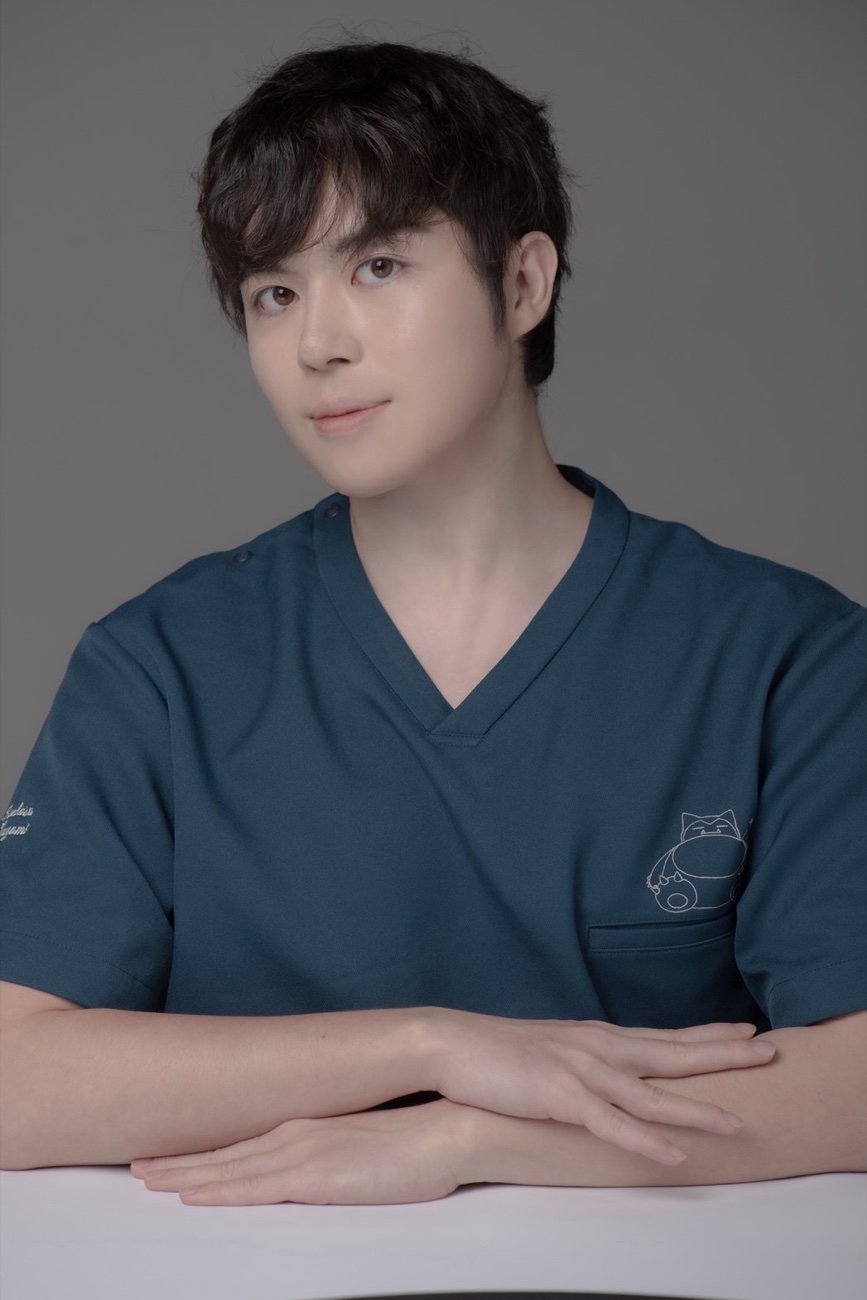
DirectorDr. Tsubasa Hayami, Clinic Director
A cosmetic surgeon who provides refined facial contouring based on careful design and medical evidence. Focusing on facial liposuction, contouring, and injectables, he designs where to reduce and where to add as one face. He draws on his experience in ophthalmology in designing the eye area, such as under the eyes and the mid-cheek groove.
— Specialties: facial liposuction / slim-face design / facial contouring / injectables / upper arm and leg liposuction
- Graduated from Kanazawa Medical University
- Department of Ophthalmology, Juntendo University
- Director, Tennoji branch of a major cosmetic surgery clinic
- Wing clinic Toyonaka opens
- Botox Vista / Juvéderm Vista certified doctor
- Alma Tune Lifting certified physician
- Onda Lift Kansai training physician / Oligio Kiss certified physician
- Facial liposuction: 1,000+ cases (Apr 2023 – Oct 2026)
PricePrices
All prices include tax.
Fat grafting is performed as a set of "fat harvesting and CRF preparation" and "fat grafting (per area)."
Model prices require that you agree to the use of case photos on social media, etc.
BASICWing Fat Grafting (face)
Not charged when done on the same day as leg liposuctionRegular price (incl. tax)150,000 yenModel price (incl. tax)120,000 yen
For areas with thin skin, such as under the eyes. The doctor will advise whether it is neededRegular price (incl. tax)150,000 yenModel price (incl. tax)−
OPTIONOptions
Total ExamplesSample totals (including anesthesia)
*All treatments shown are self-pay (not covered by insurance; paid in full by the patient).
*The total examples include an anesthesia fee of 55,000 yen (IV sedation; includes the nitrous oxide sedation fee). There are no model prices for nanofat processing or anesthesia.
*If re-injection is done after the 3-month evaluation, the standard fee applies again.
*Included in the price: consultation (free) / post-surgery follow-up / aftercare. Medical loans and installment payments are available.
*Results vary from person to person. The final price is presented after your examination.
FlowThe treatment process
From consultation to the evaluation 3 months later. On the day of surgery, harvesting to injection takes about 90–120 min, and you can go home the same day.
- 01approx.60 to 90 min
- Consultation
We examine the balance of your whole face and propose the areas, amounts, and processing method. We check the condition of the thighs to be harvested, smoking, medical history, and medications, and present an estimate.
- 02approx.20 min
- Arrival, marking, and anesthesia
After the medical interview, we design and mark the areas to inject and the thigh area to harvest. Nitrous oxide sedation eases your nerves, then IV sedation is given.
- 03approx.90–120 min
- Harvesting, purification, processing, and injection
Harvest from the thighs → purify (CRF) → process (LipoCube Nano) → inject. Fat is injected little by little in separate layers.
- 04Same-day discharge
- Recovery and going home
You rest in the clinic while we confirm your recovery from anesthesia. We explain post-operative care and medication, and you can go home the same day. We recommend someone pick you up.
- 05After surgery 1 and 3 months
- Progress check and evaluation of what remains
We check your progress at 1 and 3 months. At 3 months we evaluate how much has remained, and if needed you can consult us about re-injection (charged separately).
* Times are approximate and may vary depending on the day, so please allow plenty of time.
DowntimeDowntime timeline
For about 2 weeks after surgery, it may look overfilled because of swelling and the volume before absorption. Not only the face: the thighs where fat was harvested also have downtime.
Guide to swelling and puffiness (relative image, with the post-surgery peak as 100)
Pain at the harvest site
Peak
starts to subside
go out in public
goes away
Consultation on re-injection
stabilizes
★ Guide to returning to daily life:1 to 2 weeks or so after surgery. Some people return to desk work within a few days. Bruising at the harvest site is hidden by clothing.
-
- Inflammatory phaseDAYS 1–7
Swelling and bruising peak at 2 to 3 days after surgery. The harvest site has pain like muscle soreness for a few days to 1 week (managed with painkillers). Do not over-cool the face or massage it hard.
-
- Recovery phaseWEEK 2–3
Facial swelling goes down considerably, and many people find it easier to be seen in public. Bruising at the harvest site fades in 2 to 3 weeks.
-
- Settling phaseMONTHS 1–3
Puffiness and the absorbed portion go down, and the amount that remains becomes visible. Firmness at the harvest site mostly softens in 1–3 months.
-
- Stable phaseMONTH 3–6
The remaining fat settles, and the result stabilizes. We evaluate at 3 months and, if needed, you can consult us about re-injection.
RecoveryReturning to daily life
-
- Makeup and face washingGuide
Resume face washing and makeup about 5–7 days after treatment. Even after resuming, avoid rubbing the injected areas.
-
- BathingGuide
Showers from around the next day, as instructed by the doctor. Baths after about 1 week, depending on swelling and the condition of the harvest-site wounds.
-
- Exercise and alcoholGuide
Increased blood flow prolongs swelling, so alcohol and light exercise from 2 weeks onward, and full exercise from 1 month onward, as a guide.
-
- Care for the harvest siteGuide
If you have fat grafting only, no compression garment is needed. Don’t massage firmly. If done on the same day as leg liposuction, follow the liposuction aftercare.
* These are general guidelines. The course, duration, and degree vary by individual and with the amount, areas, and any combination treatments. Always follow your doctor’s instructions for post-operative care.
RiskRisks and how we handle them
Every treatment carries risks. We tell you in advance what can happen and how we respond if it does.
- 01
- Swelling and bruising
Injection sites: about 1 to 2 weeks; harvest site: about 2 to 3 weeks. The area under the eyes is prone to bruising. The harvest site may also feel tired or have a mild fever.
- 02
- Lumps, firmness, irregularities
Caused by fat necrosis (fat that didn’t survive hardening), oil cysts, or calcification. Most settle within a few months; if they remain, we examine them and treat as needed.
- 03
- Insufficient effect or asymmetrydue to absorption
The proportion that remains varies, and if more is absorbed, the result may look smaller than planned. We evaluate at 3 months, and you can consult us about re-injection (standard fee).
- 04
- Overcorrection /too much fullness
Because we inject with absorption in mind, it will look fuller for a while after treatment. Fat that remains can swell with weight gain, and excess fat is difficult to remove, so we design conservatively.
- 05
- Irregularities, numbness, or scarsat the harvest site
Over-harvesting can cause irregularities. Reduced sensation usually recovers within a few months. Scars of a few millimeters and pigmentation are made less noticeable with sun protection and taping.
- 06
- Infection
Managed with sterile technique and preventive antibiotics. If it occurs, we give antibiotics and treat it.
- 07
- Injection into a blood vessel(extremely rare)
If fat enters a blood vessel, it can lead to serious complications such as impaired blood flow to the skin, vision problems, or stroke. We inject small amounts at low pressure with a blunt-tipped cannula, taking particular care under the eyes, on the forehead, and between the eyebrows.
- 08
- Anesthesia-related risks
Nausea, allergies, respiratory depression, etc. Performed under monitoring, with a detailed review of your medical history and allergies.
Who cannot have this treatment
- People who are pregnant or breastfeeding
- People with serious chronic illness or who take anticoagulants
- People with serious heart disease, diabetes, or systemic muscle disease
- People with inflammation or wounds at the injection or harvest sites
- People who are extremely thin and from whom the fat needed cannot be harvested
- People who have had or plan to have a vaccination within 2 weeks
- People with soy or egg allergies (because IV sedation cannot be used)
Request to stop smoking
Injected fat is supported by surrounding blood flow until new blood vessels connect. Tobacco (including heated tobacco and nicotine e-cigarettes) reduces that blood flow and the amount of fat that remains. We ask you to stop smoking for 1 month both before and after surgery, and if you cannot cooperate, you may not be able to receive the treatment. Please be sure to tell us at your consultation whether you smoke.
Precautions
- If you have had a cosmetic treatment at another clinic within the past month, please tell us in advance.
- If you have ever had an allergic reaction to anesthetics or medication, please tell us in advance.
- If you take medication or supplements that thin the blood (other than anticoagulants), the risk of bruising may be higher, so please tell us in advance.
About unapproved medical devices
LipoCube Nano, used for nanofat and microfat processing, is a medical device that has not been approved in Japan under the Act on Pharmaceuticals and Medical Devices. How it is obtained and whether approved products exist in Japan are described under "Purification and processing." This treatment is self-pay.
* Our system for responding to complications is supervised by a board-certified emergency physician (emergency medicine advisor Dr. Takashi Fuse).
FAQFAQ
QIs one session enough? How much of the injected fat remains?
The proportion that remains varies; we inject with absorption in mind and evaluate at 3 months. For some people one session is enough, while others add more with re-injection (charged separately).
QWhat is CRF (condensed rich fat)? How is it different from ordinary fat grafting?
It is a purification method that removes anesthetic fluid, blood, and oil by centrifugation and concentrates the fat. It is standard for every case at our clinic because it makes it easier to predict how much of what is injected will remain (included in fat harvesting and CRF preparation, 150,000 yen).
QWhere is the fat taken from? Is it OK if I’m slim?
Fat is harvested from the thighs. The face doesn’t need a large amount, so in most cases fat can be harvested even from slim people. If the amount needed can’t be harvested, we will suggest another method such as hyaluronic acid.
QWill it form lumps?
We lower the risk of lumps by removing oil with CRF, evening out the particles with LipoCube Nano, and injecting small amounts in separate layers. Even so, the risk isn’t zero. Most lumps settle within a few months; if they remain, we examine and treat them.
QHow much swelling and downtime is there? When can I go back to work?
Facial swelling peaks 2–3 days after treatment and usually settles in 1–2 weeks. The thighs feel sore like muscle pain for a few days to 1 week, with bruising for 2–3 weeks. As a guide, people return to desk work after a few days to 1 week and to jobs where they meet people after 1–2 weeks (this varies by individual).
QIs nanofat processing required?
It isn’t required. We suggest using it in the shallow layer in areas with thin skin where irregularities appear easily, such as under the eyes. It is not used for adding volume (option: 150,000 yen).
QWhich is better, fat grafting or hyaluronic acid?
Hyaluronic acid suits those who want to try once first or keep downtime short, while fat grafting suits those who want to refine a wide area for the long term or avoid foreign substances. The two can also be combined.
QWill the injected areas change if I gain or lose weight?
They may. The fat that remains is your own fat cells, so it may swell if you gain a lot of weight and shrink if you lose weight. We recommend not changing your weight significantly for 3 months after treatment.
QCan I have this treatment if I smoke?
We only treat patients who can cooperate with stopping smoking for 1 month before and after treatment; the same applies to heated tobacco and e-cigarettes. If that is difficult, please talk to us about adjusting the timing or another method.
Contact us Booking & Inquiries
You can also book or ask questions via LINE!
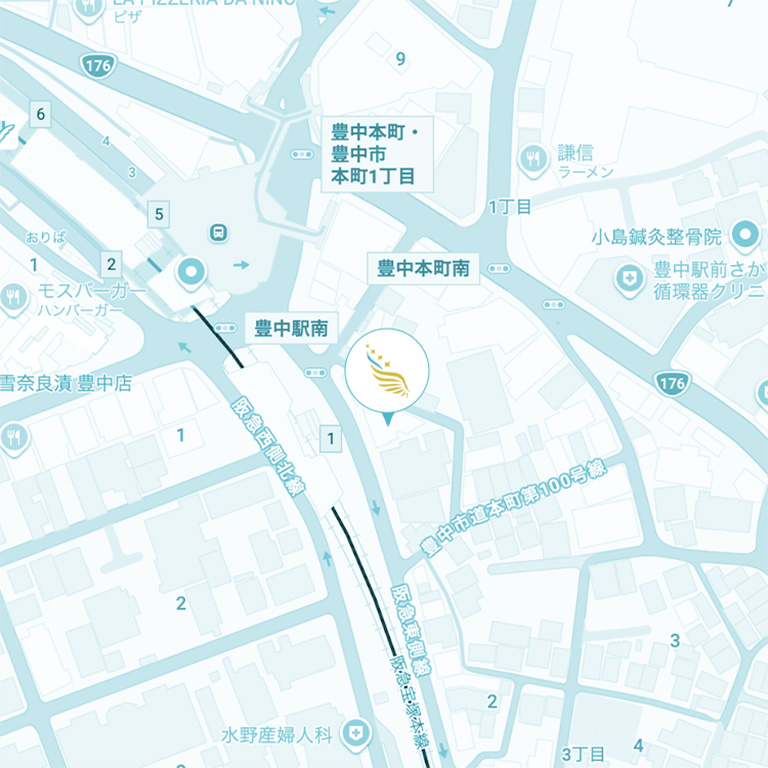
Access
View on a larger map4F Toyonaka Ekimae Yasuda Building, 1-2-35 Honmachi, Toyonaka, Osaka
- 1 minute walk from Hankyu Toyonaka Station / 11 minutes by train from Umeda Station
- 15 minutes from Itami Airport / 15 minutes from Shin-Osaka Station
Hours
10:00–20:00 (last entry 19:00)
Closed: irregular *For more information, please contact us.
Departments: Cosmetic Dermatology, Cosmetic Surgery, Internal Medicine, Dermatology