
1 minute from Toyonaka Station
Shadow-free eyes, without over-removal.
OsakaUnder-Eye Bag and Dark Circle Removal(removing under-eye bags)
Transconjunctival fat removal takes out orbital fat from the inside of the eyelid. It leaves little visible scarring and needs no stitch removal.
Wing clinicToyonaka
Booking & Inquiries 06-6318-8774 Call
[Hours] 10:00-20:00 / Last entry 19:00
Improving dark circles caused by bags,
for brighter-looking eyes.
Under-eye bag removal is surgery that removes orbital fat, the cause of the bags, from the inside of the lower eyelid (the conjunctiva).
Bags under the eyes cast a shadow beneath them, making you look tired or older. Removing the fat to eliminate the step lightens the shadow and makes the whole eye area look brighter. But if too much is removed, the hollow becomes a new shadow, and fat that has been removed can’t be put back. That is why we decide "how much to leave," not "how much to remove."
Wing clinic examines three things—the size of the bags, the depth of the hollow (tear trough), and skin laxity—and designs with you whether fat removal alone will work or whether fat grafting or an incision method is needed.
— Wing clinic / DoctorContents
Tap to jump to a section
CheckWho under-eye bag removal is suited to
- Even after a good night’s sleep, people ask "Are you tired?" The area under your eyes looks dark and your whole face looks worn out
- The area under your eyes puffs out, with a shadow underneath that looks like a dark circle
- Concealer hides the color, but not the shadow from the bags
- When you smile, the bags under your eyes are emphasized and you look older than your age
- In photos or under fluorescent light, the step under your eyes stands out clearly
- You want to improve the bags themselves but want to avoid surgery that cuts the skin or leaves noticeable scars
If even one of these applies, under-eye bag removal may lighten the shadow.
However, if the cause is "color" (blue or brown circles) or "skin laxity," removing fat won’t make the shadow disappear.
Black circles (shadow type)
The step below the bags becomes a shadow and looks dark. It lightens when you look up.
Treated by fat removalBrown circles
Pigmentation from rubbing or UV exposure. The color moves with the skin when you pull it. Removing fat doesn’t change the color.
Not improved by fat removalBlue circles
The skin is thin and sluggish blood flow underneath shows through. It lightens when you pull sideways toward the outer corner of the eye. Removing fat doesn’t change the color.
Difficult to improve with fat removal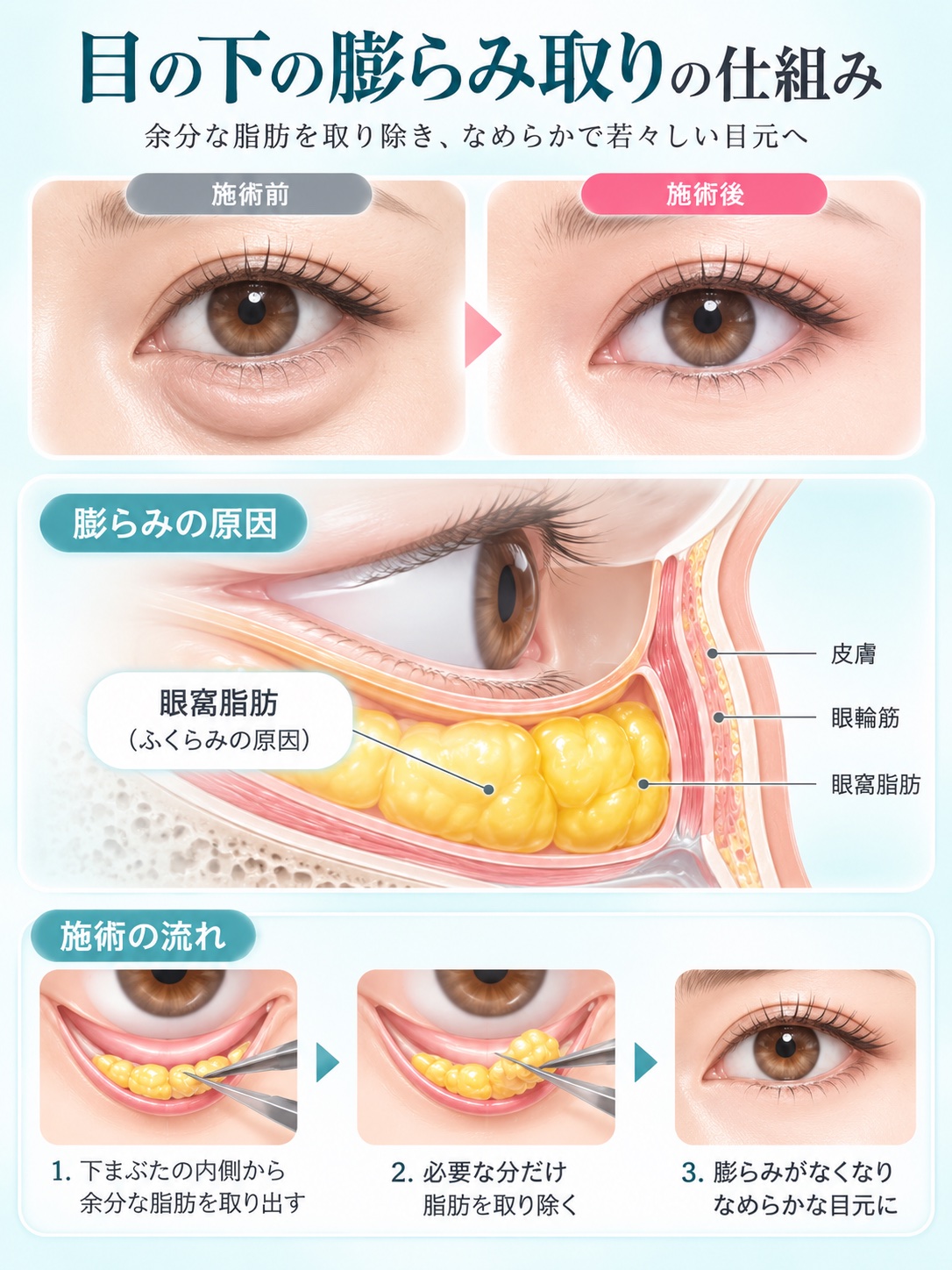
MechanismHow under-eye bags and shadows form
The bags are made of "orbital fat," which cushions the eyeball from below. It is normally held in by a thin membrane called the orbital septum, but when the membrane and the orbicularis oculi muscle loosen with age, the fat is pushed forward and appears as bags under the lower eyelid. Depending on the shape of the eye socket and the height of the cheekbones, they can also appear in young people.
Below the bags, at the boundary between the orbicularis oculi muscle and the cheek fat, there is a ligament that anchors the skin to the bone. It remains as a groove (the tear trough), creating a step between it and the bags, and when light falls from above, the area below the step becomes a shadow. This is what a "shadow-type dark circle" really is.
Transconjunctival fat removal takes out this fat through an incision of a few millimeters on the inside of the lower eyelid (the conjunctiva). Because neither the skin nor the orbicularis oculi muscle is cut, little scarring is visible on the surface, and the conjunctiva closes naturally without stitches. The fat is divided into three compartments—inner, middle, and outer—and we examine how much each one protrudes and decide how much to remove from each. Skin laxity, on the other hand, isn’t improved by removing fat, so an incision method is better suited to people whose main concern is sagging skin.
Five PrinciplesFive things we protect in under-eye bag removal
Once you understand how bags and shadows form, what to protect in surgery follows.
These are the five principles behind Wing clinic’s design for under-eye bag removal.
- 01
- Only the conjunctiva is cut
In fat removal, only a few millimeters of the conjunctiva on the inside of the lower eyelid are cut. Neither the skin nor the orbicularis oculi muscle is cut, and the conjunctiva closes without stitches.
- 02
- Each of the three compartments is assessed separately
The inner, middle, and outer compartments differ in how they protrude and in the effect of over-removal. We don’t remove the same amount from each; we decide how much to leave in each compartment.
- 03
- Stop at the boundary with the cheek
The upper limit for removal is a surface that blends smoothly into the cheek. We don’t remove beyond it in an attempt to erase the groove (tear trough).
- 04
- Err on the side of leaving more
Fat left behind can be added to later, but over-removal can’t be undone. Anticipating changes in the cheeks 10 years from now, we stop conservatively the first time.
- 05
- Tell you honestly, up front
For deep hollows we suggest fat grafting; for excess skin, a lower eyelid lift. If fat removal alone won’t do the job, we tell you so in advance.
MethodsTwo surgical plans
If bags are the only cause, transconjunctival fat removal alone will refine the area. If there is a hollow below the bags, we "remove and add." If skin laxity is the main issue, we "refine the skin as well." Wing clinic examines whether bags, hollows, or laxity are the main cause of the shadow and chooses fat removal alone or one of two combination plans.
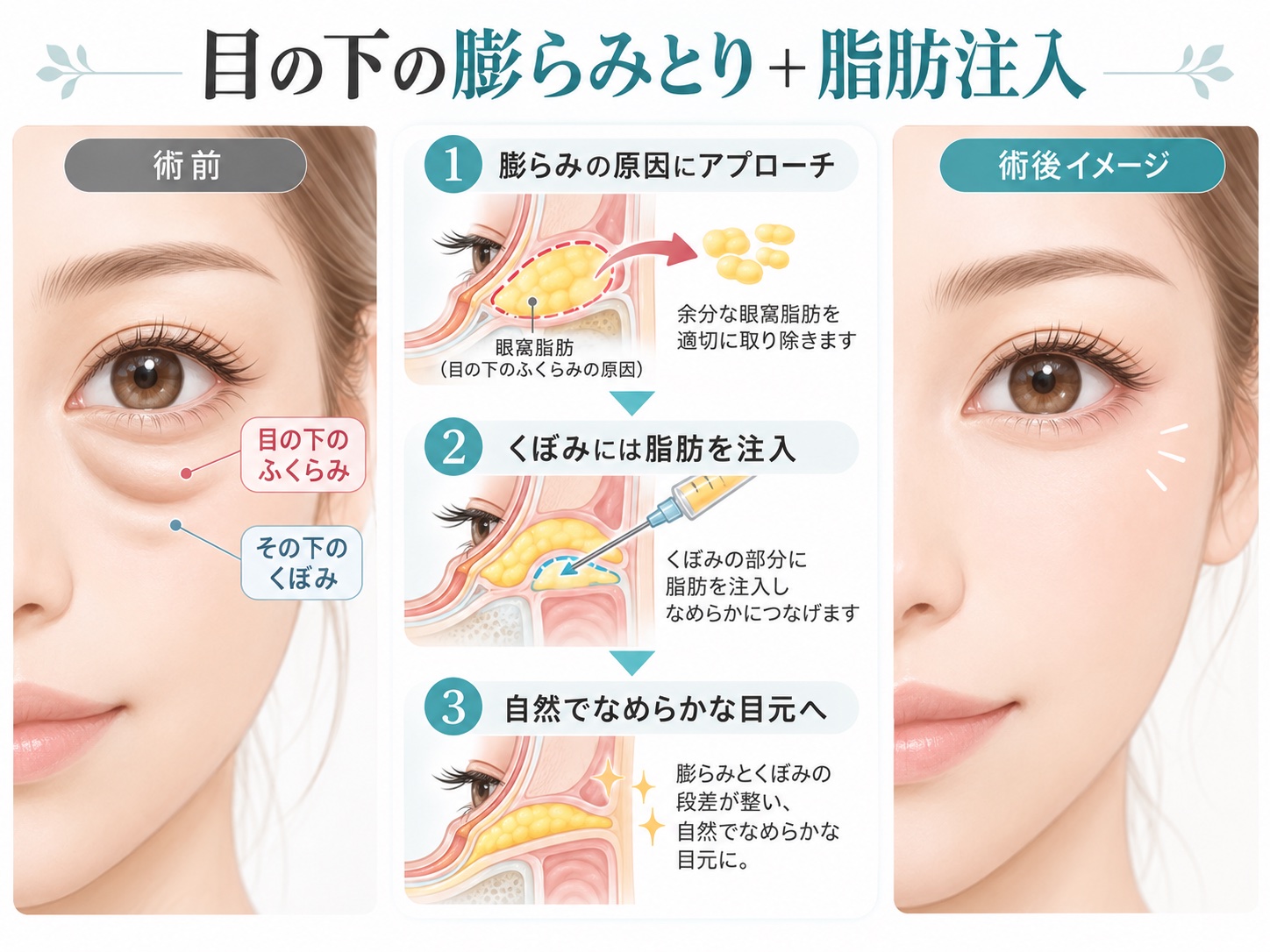
StandardTransconjunctival fat removal + fat grafting
Orbital fat is removed from the inside of the lower eyelid (the conjunctiva) to flatten the bags, and fat harvested from the thighs is added to the hollow below (tear trough and mid-cheek groove) and the upper cheek. Removing the bags alone can leave existing hollows or gaunt cheeks, so the shadow may not fully disappear. By designing "removing" and "adding" on the same day, we create one smooth surface from under the eyes to the cheeks.
Because fat removal is done from the inside, little scarring is left on the skin and no stitch removal is needed. The fat to be injected is purified by centrifugation, broken down finely, and injected little by little under the thin skin beneath the eyes. Injected fat that connects to a blood supply remains; the rest is absorbed over a few months. Because the amount that remains varies, we evaluate the result at 3 months, and you can consult us about additional injection if needed (charged separately).
- Refines bags and hollows in a single treatment.
- Fat removal from the inside: little visible scarring and no stitch removal.
- Fat is purified and broken down finely before injection, and injected little by little with care for irregularities under thin skin.
- Because it is your own tissue, there is little concern about allergies.
- Creates a smooth surface that includes the upper cheek.
- Because the thighs where fat is harvested also swell and bruise, treatment time and downtime are longer.
Suited to: people with hollows or gaunt cheeks below the bags, for whom fat removal alone is likely to leave a shadow. People whose skin is firm without noticeable sagging.
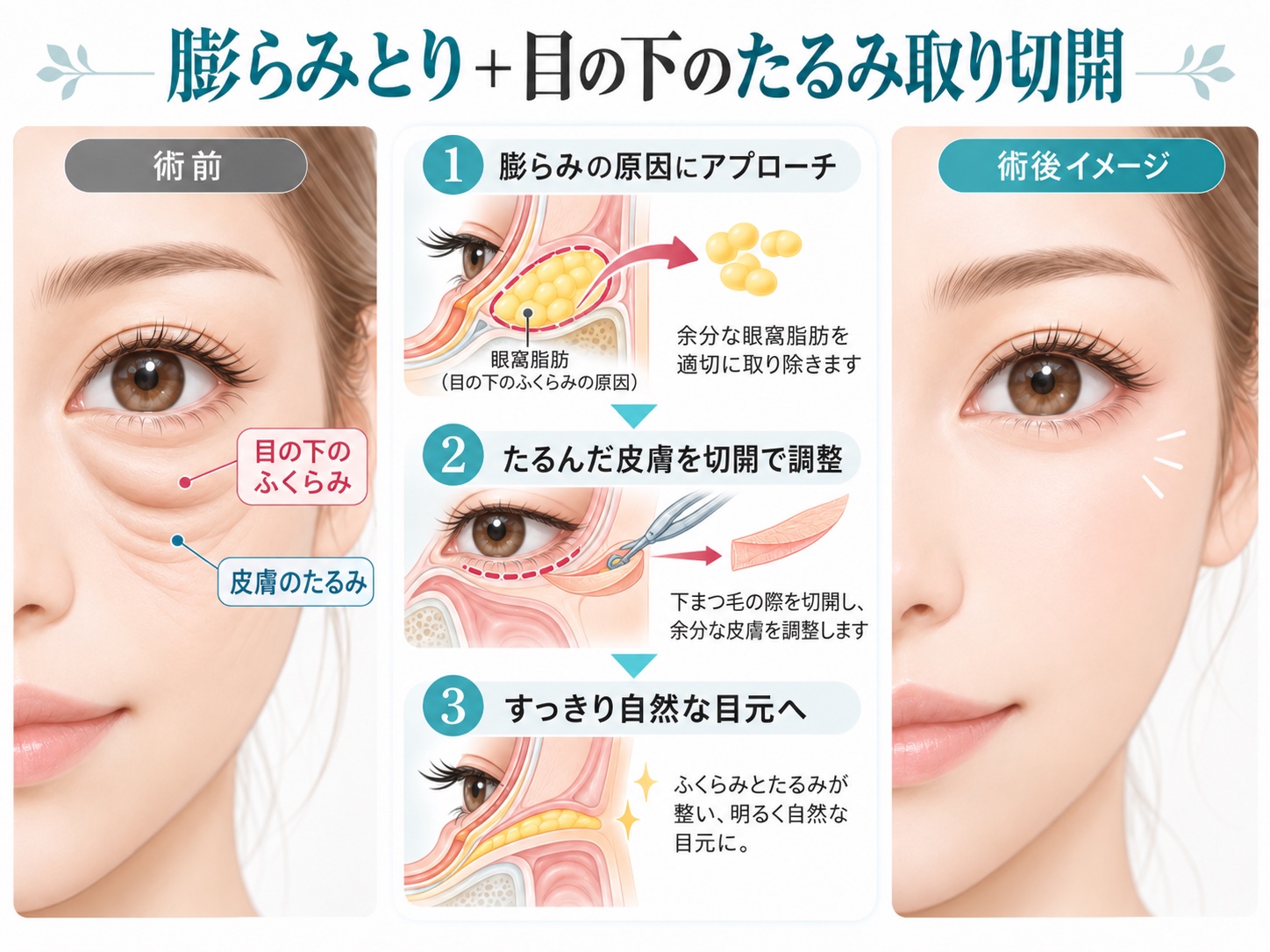
For significant saggingTransconjunctival fat removal + lower eyelid lift (incision)
After orbital fat is removed from the inside of the lower eyelid (the conjunctiva), an incision is made just below the lash line, and excess skin is removed and sutured. Because it also refines sagging skin and fine lines that fat removal alone can’t address, it suits people whose main concern is sagging rather than bags.
Removing fat alone can leave stretched skin with noticeable fine lines. This combination treats the bags and the excess skin at once. The amount of skin removed is determined within a range that keeps the shape of the eyelid, so that it doesn’t turn outward (ectropion). Stitches are removed after about 1 week, swelling lasts 2–3 weeks, and redness of the scar settles over several months.
- Also refines sagging skin and fine lines that fat removal alone can’t address.
- Treats bags and excess skin in a single treatment.
- The scar follows the line just below the lashes, so it becomes less noticeable over time.
- We don’t remove too much skin; the amount is decided within a range that keeps the shape of the eyelid.
- For about 1 week until stitch removal, and for several months until the redness of the wound fades, a period of watching progress is needed.
Suited to: people whose sagging skin and fine lines are more noticeable than the bags. Mainly people in their 50s and older, for whom fat removal alone is likely to leave excess skin.
ComparisonHow it compares with transconjunctival Hamra
Both are performed from the conjunctival side and leave no surface scar. The difference is whether fat is "removed" or "moved." Which one is suitable depends on whether bags or hollows are the main issue.
| Comparison | Under-eye bag removal (transconjunctival fat removal) | Transconjunctival Hamra |
|---|---|---|
| What happens to the fat | Excess fat is removed | Fat is not removed but moved into the hollow (tear trough) and secured |
| Best for | People whose main issue is bags, with hollows that aren’t noticeable | People with clear bags and hollows |
| Downtime guide | Swelling and bruising: 1–2 weeks | Somewhat longer than fat removal |
| Cost (incl. tax) | 198,000 yen (model price: 98,000 yen) | 598,000 yen (model price: 498,000 yen) |
* Both are performed through an incision on the inside of the lower eyelid (the conjunctiva), with no surface scar and no stitch removal. Neither method improves skin laxity on its own, so for significant sagging, METHOD 02 (fat removal combined with an incision method) is an option. Suitability depends on the condition of the bags, hollows, and laxity, not on age alone.
Three steps of surgery
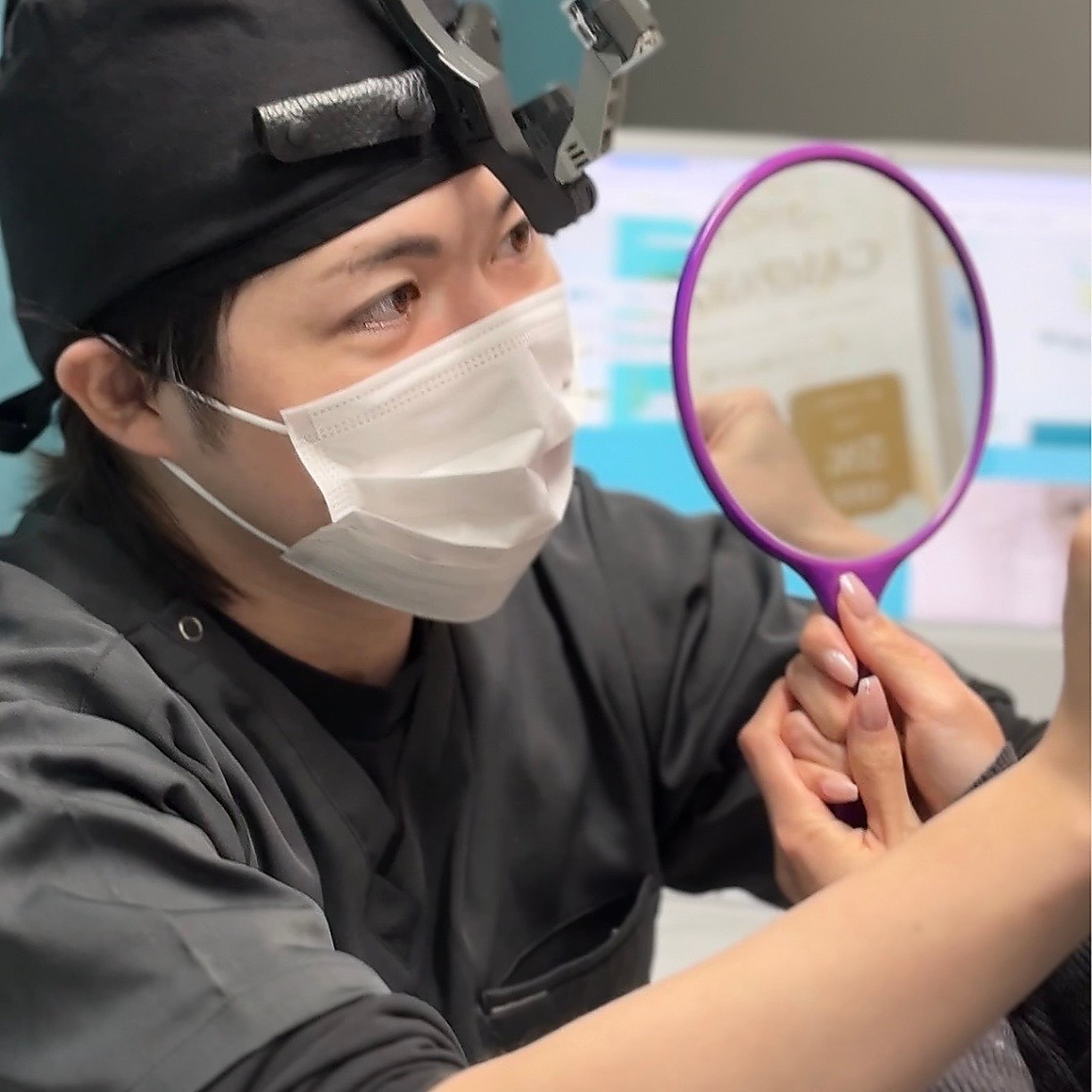 STEP 01
- Design and simulation
Looking in a mirror, we examine the bags, hollows, and laxity and decide together on the method and "where to stop."
 STEP 02
- Treatment
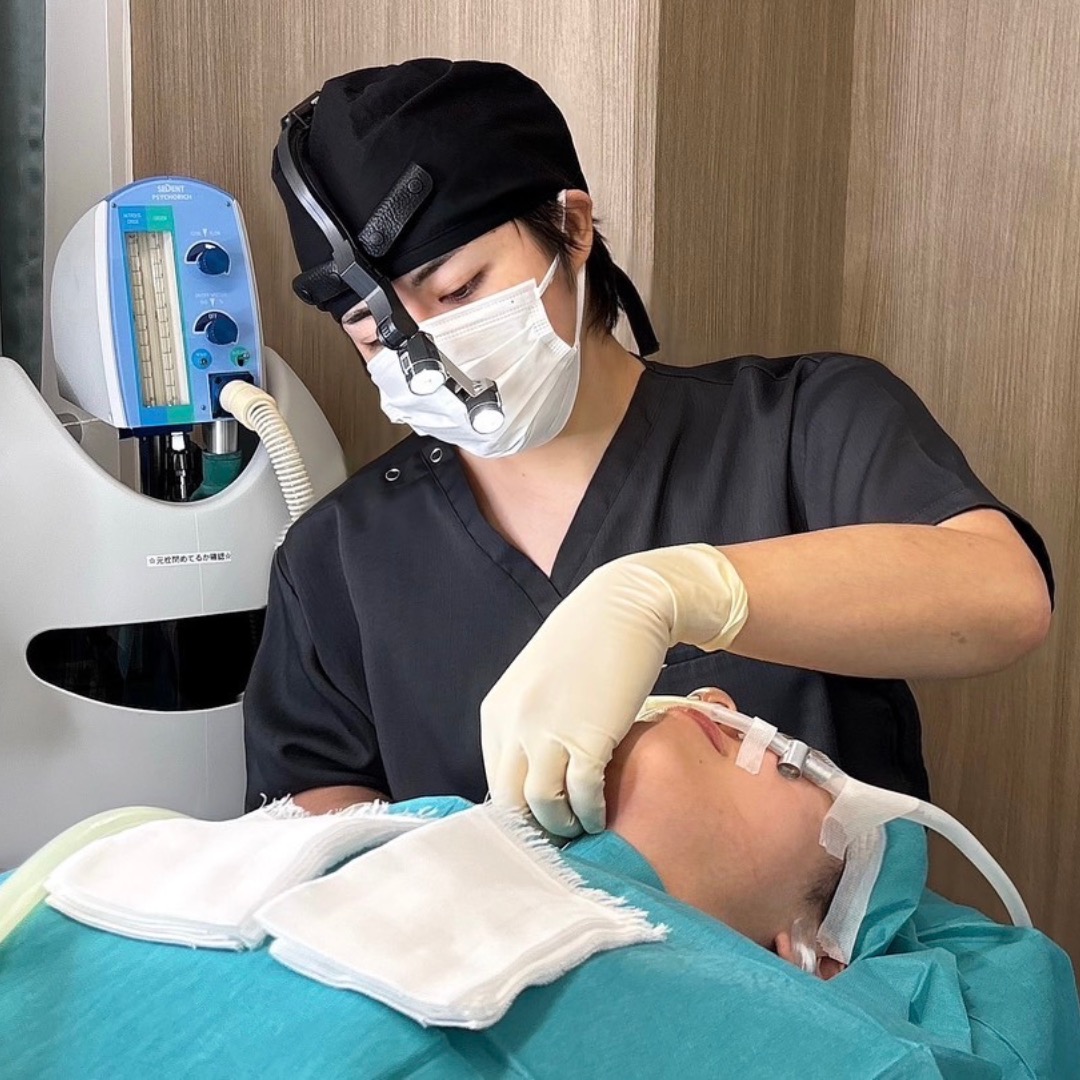
After local anesthesia on the conjunctival side (with nitrous oxide sedation on request), fat is removed compartment by compartment from the inside of the lower eyelid while checking under magnification. We compare the bags on both sides to finish without any difference.
 STEP 03
- Powder room
After we explain post-operative care and precautions, you go to the powder room, where we provide powder for touching up your makeup. You can get ready before going home.
Points"Where to stop" determines the result
The result of fat removal depends less on removal technique than on deciding "where to stop."
Here are the signs of over- and under-removal, and the criteria Wing clinic uses to stop.
Fat that has been over-removed can’t be put back.
So we decide "where to stop" before we start.
-
01
- Signs of over-removal and under-removal
-
Both leave a shadow, but for opposite reasons. Under-removal can be corrected later, but over-removal can’t be fully restored to the original surface even with fat grafting. That is why our judgment leans toward not removing too much.
- Over-removal: the area under the eyes looks lower than the cheeks when sitting / the bony rim stands out / the area under the eyes sinks when you smile
- Under-removal: there is still a bag that lightens when you look up / the bag bulges when you smile
-
02
- Wing clinic’s "stopping criteria"
-
The upper limit is "a surface that blends smoothly into the cheek." We don’t flatten beyond it. Orbital fat is divided into three compartments—inner, middle, and outer—that differ in how they protrude and in the effect of over-removal, so we vary how much to leave in each.
- Middle: the compartment that protrudes most. Stop where it is level with the cheek
- Outer: over-removal causes a hollow toward the outer corner, creating a shadow instead. Be conservative
- Inner: under-removal is easily noticeable. Check bags on the nose side carefully
- 10 years from now: cheek fat descends, bone thins, and the eye socket widens. "Just right now" becomes over-removal in the future, so be conservative the first time
"Conservative" is not the goal but the means of erasing the shadow.
For those likely to have hollows or gaunt cheeks, we design fat grafting, and for those with excess skin, a lower eyelid lift, at the same time as fat removal.
Commitment3 Commitments at Wing clinic
To turn the "where to stop" design directly into your result,
here are three things Wing clinic never compromises on during surgery.
Don’t remove fat you can’t see
Under the eyes, the slightest under- or over-removal becomes a shadow or hollow. Rather than pulling fat out blindly, we directly check each compartment under magnification and remove only the portion that forms the bag.
Stop the bleeding in each compartment before moving on
The conjunctival side is rich in blood vessels, and the care taken to stop bleeding directly affects how much bruising there is. We confirm bleeding has stopped in each of the inner, middle, and outer compartments before moving on, keeping post-operative bruising to a minimum.
Prepared for the unexpected
With Dr. Takashi Fuse, a board-certified emergency physician, as our emergency medicine advisor, we have response procedures in place for complications and sudden changes in condition. If any symptoms concern you after surgery, we check your progress at an examination.
AnesthesiaAbout anesthesia
This surgery is performed under local anesthesia. Depending on your level of anxiety, we combine it with nitrous oxide sedation or IV sedation.
-
01
- Local anesthesia (injection)
-
Anesthetic is injected into the conjunctiva (the inside of the lower eyelid) with an ultra-fine needle.
- You are conscious during treatment and will still feel pressure
- Dull pain after the anesthetic wears off is managed with painkillers
- Local anesthesia: included in the treatment price
-
02
- Nitrous oxide sedation
-
Anesthesia in which you inhale an odorless gas that eases tension while you stay conscious. Used in combination with local anesthesia.
- Works right after inhaling and wears off quickly once stopped
- For people who are afraid of injections or anxious about work near the eyes
- Price: 5,500 yen
* Whether anesthesia is needed and which combination to use are proposed according to your wishes. Local anesthesia is included in the treatment price.
* For under-eye bag removal, IV sedation is also available on request (55,000 yen, including nitrous oxide sedation). If fat grafting is combined, both nitrous oxide sedation and IV sedation are required.
DoctorOur Doctors
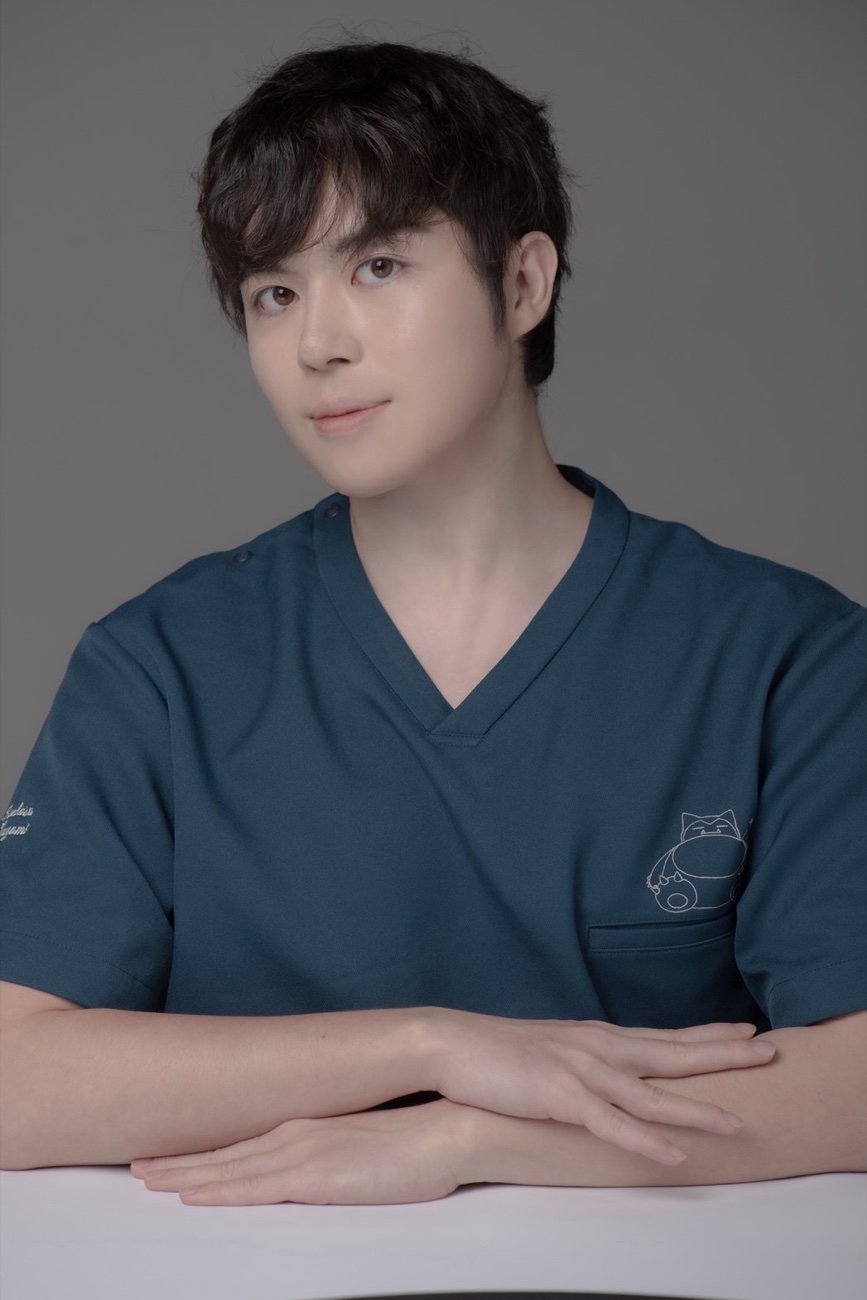
DirectorDr. Tsubasa Hayami, Clinic Director
A cosmetic surgeon working from careful design and medical evidence. He draws on his experience in ophthalmology in designing the eye area, such as under the eyes and the mid-cheek groove, and plans where to reduce and where to add as one face.
— Specialties: injectables / facial liposuction / slim-face design / facial contouring / upper arm and leg liposuction
- Graduated from Kanazawa Medical University
- Department of Ophthalmology, Juntendo University
- Director, Tennoji branch of a major cosmetic surgery clinic
- Wing clinic Toyonaka opens
- Botox Vista / Juvéderm Vista certified doctor
- Alma Tune Lifting certified physician
- Onda Lift Kansai training physician / Oligio Kiss certified physician
- Facial liposuction: 1,000+ cases (Apr 2023 – Oct 2026)
PricePrices
All prices include tax.
Model prices require that you agree to the use of case photos on social media, etc.
BASEUnder-eye bag removal (transconjunctival fat removal only)
METHOD 01Transconjunctival fat removal + fat grafting
METHOD 02Transconjunctival fat removal + lower eyelid lift (incision)
RELATEDHamra technique
OPTIONAnesthesia options
OPTIONDoctor request, additions, and same-day treatments
* All treatments shown are self-pay (not covered by insurance; paid in full by the patient). Prices include tax.
* Model prices are for patients who agree to have their case published in photos, on social media, etc.
* How results are felt varies by individual. Prices may vary depending on the examination results and the treatment. The final price will be presented after your consultation.
* Transconjunctival fat removal requires no stitch removal, and follow-up visits are generally not needed. Follow-up examinations are included in the treatment price.
* Prices include: consultation (free) / local anesthesia / post-operative follow-up (progress consultations and check-ups) / aftercare
* The fat removal + fat grafting set is offered at a set discount, lower than the total when each is done separately.
CasesCases
-
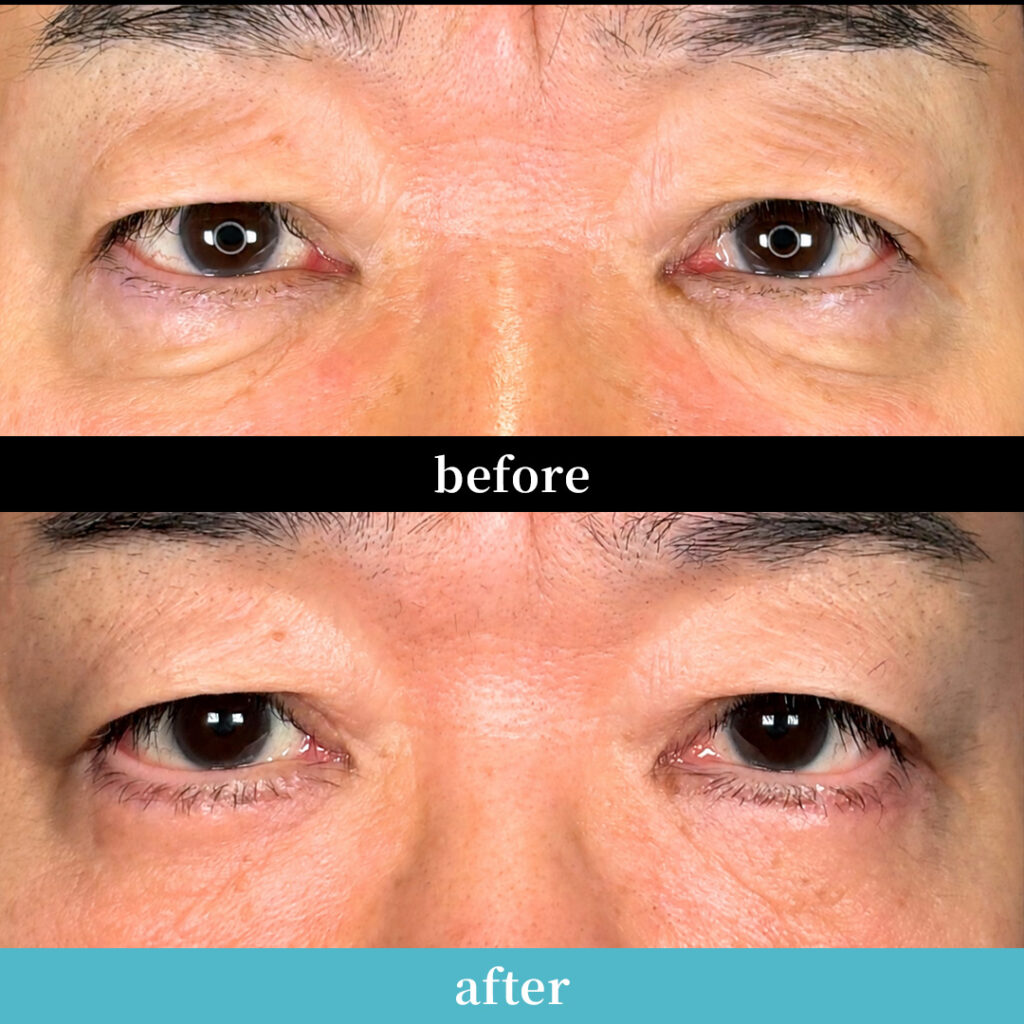
- Lower Eyelid Lift (Male, 2025.11)
- Treatment
- Lower Eyelid Lift
- Price (incl. tax)
- 104,250 yen and up398,000 yen (regular price)
- Risks and side effects
- Visible scarring, asymmetry, altered sensation, thickened scars or keloids, dry eyes or a foreign-body sensation, dissatisfaction with the result
- View case details
-
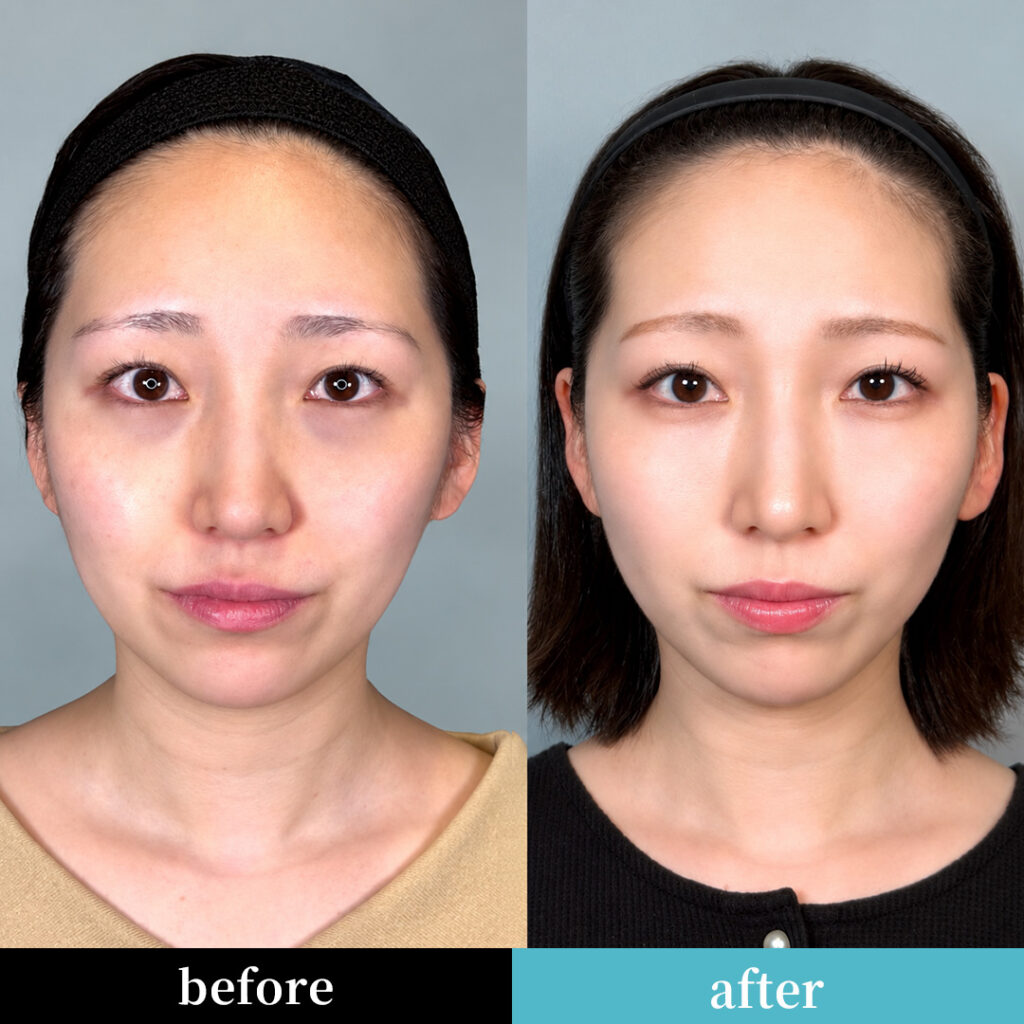
- Under-Eye Bag Removal (Female, 20s, 2026.02)
- Treatment
- Under-eye bag removal
- Price (incl. tax)
- 98,000 yen and up198,000 yen (regular price)
- Risks and side effects
- Re-expansion of fat, asymmetry, worsening of eyelid drooping, bruising
- View case details
* These treatments are self-pay (not covered by insurance). Results vary by individual, and treatment involves downtime such as swelling and bruising.
FlowOn the day of treatment
About half a day from arrival to treatment. You can go home the same day.
- 01Approx. 10 min
- Arrival and check-in
On the day, please come without eye makeup and bring your glasses (contact lenses will be removed).
- 02approx.60 to 90 min
- Consultation and design
We examine the bags, hollows, and laxity, and decide on the method together while checking in a mirror. We also explain prices and risks.
- 03About 10–15 minutes
- Anesthesia
Local anesthesia is given on the conjunctival side with an ultra-fine needle. Nitrous oxide sedation is added on request. If fat grafting is combined, IV sedation is also used.
- 04Approx. 30 to 60 min
- Fat removal
Fat is removed compartment by compartment, comparing the bags on both sides as we finish. When combined with fat grafting, harvesting and purification (about 90–120 minutes) are added.
- 05Approx. 15 to 30 min
- Cooling and rest
You rest in the clinic while cooling the area, and we check how you are feeling.
- 06Same-day discharge
- Going home and aftercare
You go home the same day with your instructions and medication (such as eye drops). There are no stitches to remove, and follow-up visits are generally not needed.
* Times are approximate and may vary depending on the day, so please allow plenty of time.
DowntimeDowntime timeline
Because the skin isn’t cut, swelling lasts a shorter time than with incision methods. The shape stabilizes over 1–3 months.
* The course varies by individual.
Guide to swelling and bruising (relative image, with the post-surgery peak as 100)
Cooling
Peak
Eye makeup and contact lenses resume
slight puffiness remains
and the shape emerges
the result stabilizes
Final evaluation
★ Back to normal life: many people return to desk work the next day, and those who meet people often take 2–3 days to 1 week off. Strong swelling usually settles 1 week after surgery, and bruising can often be covered with concealer by then.
-
- Swelling peaksDAYS 1–3
Swelling and bruising peak. Redness in the white of the eye (subconjunctival hemorrhage) may appear, but it usually fades within 1–2 weeks. Keep it down with cooling and rest, and don’t rub your eyes.
-
- Settling phaseWEEK 1–3
Strong swelling subsides, and bruising fades within 1–2 weeks. You can resume eye makeup and contact lenses after about 1 week, and you begin to see the reduced bags.
-
- Blending phaseMONTHS 1–3
Puffiness clears and the flatness of the surface approaches the intended design. When combined with fat grafting, the amount of fat that takes is mostly set during these 3 months.
-
- Completion phaseMONTH 3〜
The depth of the shadow and the shape of the surface stabilize, and the final result can be evaluated. Consultations about additional fat removal take place from this point on.
* The course varies by individual. If fat grafting is combined, the harvest site will also swell and bruise for about 1–2 weeks. Contact us promptly if swelling or pain worsens or there is pus-like discharge.
RiskRisks and how we handle them
Every surgery carries risks. Most can be avoided or reduced with understanding beforehand and appropriate design and care.
- 01
- Swelling, bruising, and subconjunctival hemorrhage
Peaks a few days after surgery. Redness in the white of the eye or blood-tinged tears may appear, but most settle within 1–2 weeks.
- 02
- Asymmetry
May occur because of pre-existing differences in the bags or bone structure. We minimize it by comparing both sides during surgery, and adjust later once things have settled if needed.
- 03
- Hollows from over-removal
Fat that has been removed can’t be put back. We remove conservatively, and for those likely to develop hollows we design fat grafting as well.
- 04
- Residual bags or recurrence
Fat may be left behind, or the remaining fat may move forward again. If it concerns you, we will discuss additional fat removal once things have settled.
- 05
- Noticeable skin laxity or fine lines
Skin that was stretched by the bags may loosen, making fine lines more noticeable than before. For those whose main issue is laxity, we suggest an incision method.
- 06
- Dryness, foreign-body sensation, reduced sensation
Dry eyes or a gritty feeling may occur temporarily. Most settle within a few weeks.
- 07
- Infection (extremely rare)
Sterile technique, eye drops, and oral medication keep the incidence low. After surgery, keep the eye area clean and don’t rub it.
- 08
- Ectropion or retraction of the lower eyelid, anesthesia-related risks
Extremely rarely, the lower eyelid may turn outward or pull down. The transconjunctival approach preserves support because the skin isn’t cut, and if it does occur we respond with taping or revision. To prepare for any changes caused by anesthetics, we check your medical history and allergies in advance.
* If fat grafting is combined, risks of lumps, irregularities, calcification, contracture, scars at the harvest site, and, extremely rarely, fat embolism are added. With incision methods, there are risks of scar redness and lower eyelid ectropion. Details are explained in the consent form.
FAQFAQ
QDoes under-eye bag removal leave scars?
Because the incision is on the conjunctival side, there is no scar on the skin and no stitch removal. If fat grafting is combined, scars of a few millimeters are made at the harvest site, such as the thighs, but they generally become less noticeable over time. If a lower eyelid lift (incision) is combined, there is a scar along the line below the lashes. Its redness settles over several months, and because it follows the line, it generally becomes inconspicuous.
QIs fat removal alone enough? Do I need fat grafting?
For people whose main issue is bags, with shallow hollows and firm skin, fat removal alone lightens the shadow. For people with existing hollows (tear trough, mid-cheek groove) or gaunt-looking cheeks, fat removal alone leaves a shadow, so we suggest combining fat grafting. If only a little is needed, hyaluronic acid is also an option. We never recommend injection across the board to people for whom fat removal alone is enough.
QHow long is the downtime? When can I go back to work?
Swelling and bruising peak 2–3 days after surgery, and strong swelling settles in about 1 week. You can return to desk work the next day, and many people who meet people often take 2–3 days to 1 week off. The shape usually takes 1–3 months to stabilize.
QCould too much be removed, leaving a hollow? Can it be reversed?
Removed fat doesn’t regenerate, and correcting with fat grafting is harder than the first surgery. That is why we remove conservatively while checking under magnification, with a surface that blends smoothly into the cheek as the upper limit. If more needs to be removed, you can consult us about additional removal once things have settled.
QWill the bags come back? Will skin laxity improve?
Fat that has been removed basically doesn’t grow back, but remaining fat may move forward with age, or the cheeks may sag and make the step noticeable again. Fat removal also doesn’t improve skin laxity or fine lines. For those whose main issue is laxity, we suggest transconjunctival fat removal + lower eyelid lift (incision).
QHow is it different from transconjunctival Hamra?
Transconjunctival fat removal "removes" fat, while transconjunctival Hamra "moves fat into the hollow and secures it." Both are performed from the conjunctival side, so little surface scarring is left. If bags are the main issue, fat removal is the option; if you have both bags and hollows and don’t want to discard fat, transconjunctival Hamra is the option.
QWill blue or brown circles improve too?
What improves is "shadow-type (black) circles" created by the step from the bags. Removing fat doesn’t change the color of blue circles caused by blood flow or brown circles caused by pigmentation. However, some people find the whole area under the eyes looks brighter once the shadow is gone. If color is the main issue, we may suggest a different treatment.
QWhen can I resume makeup, contact lenses, face washing, and bathing?
You can shower (except your face) on the same day, and wash your face and wear makeup (except around the eyes) from the next day. Eye makeup and contact lenses can usually resume 1 week after surgery. Avoid baths, alcohol, and strenuous exercise for 1 week, and massaging or pressing firmly under the eyes for about 1 month. If fat grafting is combined, face washing and makeup resume after 5–7 days.
Contact us Booking & Inquiries
You can also book or ask questions via LINE!
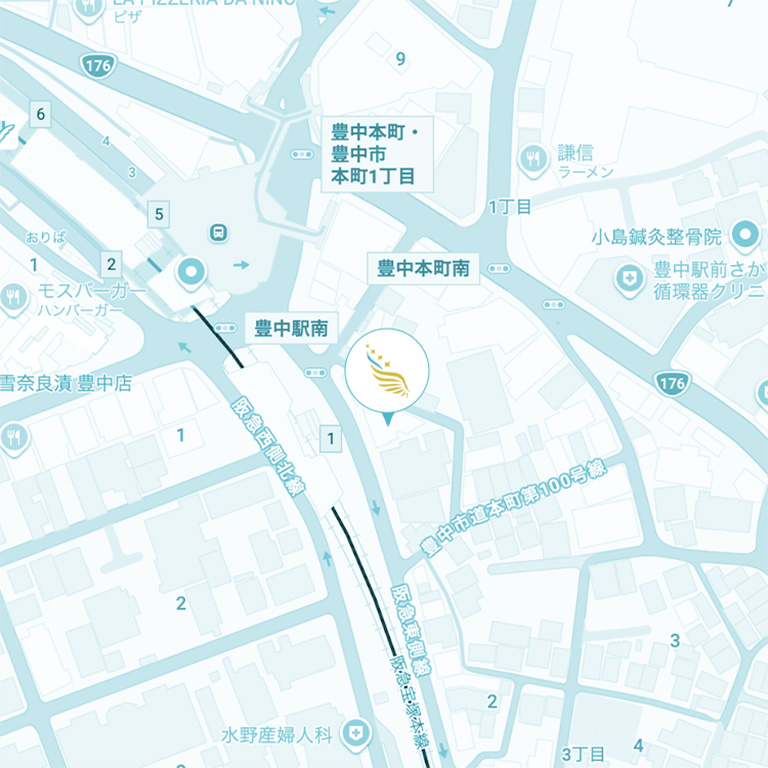
Access
View on a larger map4F Toyonaka Ekimae Yasuda Building, 1-2-35 Honmachi, Toyonaka, Osaka
- 1 minute walk from Hankyu Toyonaka Station / 11 minutes by train from Umeda Station
- 15 minutes from Itami Airport / 15 minutes from Shin-Osaka Station
Hours
10:00–20:00 (last entry 19:00)
Closed: irregular *For more information, please contact us.
Departments: Cosmetic Dermatology, Cosmetic Surgery, Internal Medicine, Dermatology