1 minute from Toyonaka Station
Natural double eyelids without large incisions.
OsakaDouble Eyelid Surgery (Buried Suture)
Point fixation, the natural adhesion method, or Secret (inside fixation). We design the best fixation method for your eyelid thickness and ideal line — double eyelids that swell less, are hard to spot, and that you’ll love for years.
Wing clinicToyonaka
Booking & Inquiries 06-6318-8774 Call
[Hours] 10:00-20:00 / Last entry 19:00
Double eyelids that still suit you 10 years from now.
The buried suture method is double eyelid surgery in which a very small opening is made with a scalpel and medical sutures are used to create the line. It places less burden on the eyelid than incision methods.
That is why, rather than chasing the trendy width, choosing "the width and fixation method that harmonize with your eyes" leads to a result you won’t regret.
Wing clinic carefully reads the thickness of your eyelids, skin laxity, and the line you want, and designs the balance between durability and naturalness.
Contents
Tap to jump to a section
CheckWho the buried suture method is suited to
- You want to stop using eyelid glue or tape every day
- You want to try double eyelids with the buried suture method first, rather than an incision method
- You want to keep downtime short
- You’re bothered that your double eyelid widths differ between eyes
- You want hooded or single eyelids to look more open
- You want to be able to reverse it if you don’t like it
If even one of these applies, you may be able to get natural double eyelids with the buried suture method.
However, depending on the thickness and laxity of your eyelids, an incision method may be better suited. The first step is to determine whether it suits you.
SUITABLEWell suited to
- The skin and fat of the eyelids are relatively thin
- The epicanthal fold is not very tight
- There is little skin laxity
- The width you want is reasonable for your current eyelids
CONSIDERNeeds careful consideration
- There is a great deal of skin laxity or fat in the eyelids
- Buried sutures have come undone many times in the past
- You strongly want a very wide, parallel double eyelid
- People with serious eye disease or a bleeding tendency
MechanismHow the buried suture method works
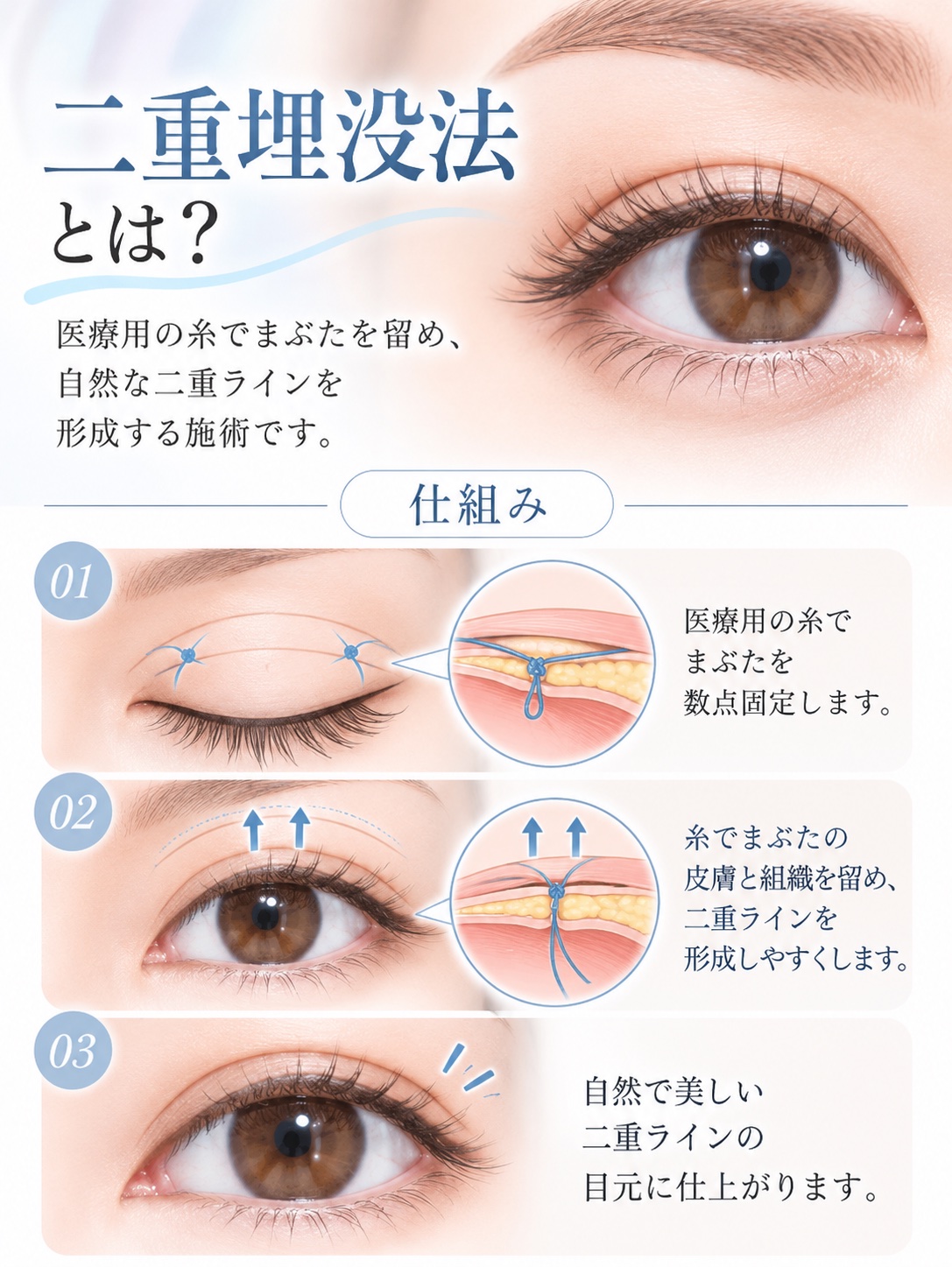
The buried suture method uses ultra-fine medical sutures to connect the eyelid skin to the tarsal plate, forming the double eyelid line. When you open your eyes, the skin folds in at the points held by the suture, creating a natural crease. Only very small openings are made with a scalpel, and because the skin isn’t cut extensively as in incision methods, downtime is relatively short, and a major advantage is that it is easier to reverse.
The result depends on the design: which method, how many points, and at what height to fix. Forcing a line that doesn’t suit the eyelid can make the fold dig in unnaturally or loosen easily. At Wing clinic, we examine your eyelids and decide the line while also checking for asymmetry.
Key PointsThree things that matterin buried-suture double eyelid surgery
The result of the buried suture method depends on three main things: the "method (fixation technique)" of how the suture is fixed, the "number of points" at which it is fixed, and "other factors (the condition of the eyelid)" such as the epicanthal fold, fat, and laxity. The combination of these three changes design reproducibility, durability, downtime, and cost.
"Which method, how many points, and how the condition of the eyelid is addressed."
These three determine the result of your double eyelids.
- 01
- Method (fixation technique)
Suture fixation methods include point fixation, which holds the eyelid at several "points"; the natural adhesion method, which threads the suture continuously to create adhesion along a "line"; and the Secret method, in which the knot is made on the inside of the eyelid. Because the method changes the area supporting the line and where the knot sits, results differ in naturalness, resistance to loosening, and how they look from the outside.
If you want to try it easily first, choose point fixation; for both naturalness and durability, the natural adhesion method; and to keep it long-lasting without anyone noticing, the Secret method. What you want to prioritize determines which method to choose.
- 02
- Number of points
Even with the same method, the number of points changes its character. Fewer points are simpler and cause less swelling, but it is harder to fine-tune the intended width and curve, and the force of blinking concentrates on one point, making it easier to loosen.
Adding points means the line is supported at multiple points, making it easier to reproduce the width and curve you want, and spreading the force improves durability. How long it lasts varies with the condition of your eyelids and your lifestyle.
03Other factors (condition of the eyelid)
In addition to the method and number of points, the condition of the eyelid also affects the result and durability.
The three main factors that make double eyelids come undone are the epicanthal fold, orbital fat, and skin laxity.
- 01
- Epicanthal fold
A fold of skin covering the inner corner of the eye. If it is tight, the line tends to come undone from the inner corner.
- 02
- Orbital fat
Fat deep in the eyelid. If there is a lot, the suture is strained every time the eyelid swells.
- 03
- Skin sagging
When the skin stretches and the eyelid becomes heavy, the force on the suture increases.
How to address each one is described in "Factors that hinder double eyelids, and treatments to combine."
The closer you want to get to your ideal double eyelid,
the more important it is to consider the method, the number of points, and all the other factors.
However, a higher-level method or more points is not always better. More points and fixation slightly increase cost and downtime, and people with thin eyelids may need only a few points. On the other hand, depending on the condition of the eyelid and the design you want, support may need to be strengthened with the method or number of points. After examining the condition of your eyelids—the epicanthal fold, fat, and skin laxity—and your wishes, we decide together on the best combination of method, number of points, and any measures needed.
MethodsHow the three fixation methods differ
Even within "the buried suture method," how the suture is fixed changes durability, naturalness, and how much it swells. Wing clinic offers three types and chooses according to the condition of your eyelids.
- Low swelling
- 1/5
- Of the three methods, this one is most likely to cause swelling.
- Durability
- 2/5
- Because it holds at points, force tends to concentrate, so it tends to loosen more easily than other methods.
- Discreetness
- 2/5
- Because the knot is made on the outside, the knot may show through.
- Design flexibility
- 2/5
- It is hard to make fine adjustments between points, so the freedom of the line is limited.
* These are our clinic’s guidelines comparing the three fixation methods. Results vary with the condition of the eyelids, the number of points, and the number of fixations.
StandardPoint fixation
The most basic buried suture method, in which the eyelid is held with sutures at several "points" (2, 4, or 6) to create the double eyelid line. An entry-level choice for those who want to "try buried sutures first."
A feature of point fixation is that its character changes with the number of points. 2-point fixation is the simplest, but with fewer points supporting the line, it loosens more easily for people with thick eyelids or who want a wide fold. The more points—4 or 6—the easier it is to finely shape the curve from the inner to the outer corner, and the force is spread out for better durability.
- The procedure is simple and finished quickly.
- You can choose the strength by the number of points (2, 4, or 6).
- Works well for people with a loose epicanthal fold and little laxity or fat.
- If needed, it is easy to reverse by removing the sutures.
- Low swelling
- 1/5
- Because a single suture is threaded widely as if sewing, swelling tends to occur, as with point fixation.
- Durability
- 3/5
- Because it supports along a line, force is spread out, and it tends to come undone less easily than point fixation.
- Discreetness
- 3/5
- The knot is on the outside, but there is only one, at the outer corner of the eye.
- Design flexibility
- 3/5
- Supporting in a line with 4 or 6 fixation points makes the line easier to shape than with point fixation.
* These are our clinic’s guidelines comparing the three fixation methods. Results vary with the condition of the eyelids, the number of points, and the number of fixations.
PopularNatural adhesion method
A method in which a single suture is sewn like a sewing machine, creating fixation points (4 or 6) as it goes, so that the eyelid tissue adheres along a "line." It aims for natural double eyelids that don’t dig in too much. 4-point and 6-point options are available. It is popular with those who want both durability and naturalness. Another feature is that if the suture ever needs to be removed, only the one knot at the outer corner has to be taken out, placing little burden on the eyelid.
Whereas point fixation supports the line at "points," the natural adhesion method supports it along a "line," so the curve of the line is easier to draw smoothly and force is less likely to concentrate at one point. It balances design reproducibility and durability.
- Because it fixes along a line, it tends to loosen less than point fixation.
- The suture’s pressure is spread out for a natural, soft line.
- Also easier to use for people with slightly thicker eyelids.
- Also chosen as a step up from point fixation.
- Low swelling
- 5/5
- Because no knot appears on the outside, it is easier to avoid a puffy look.
- Durability
- 5/5
- With many fixation points—8, 12, or 18—force is spread out, so it comes undone less easily.
- Discreetness
- 5/5
- Because no suture marks or knots appear on the outside, it is less likely to be noticed by others.
- Design flexibility
- 5/5
- With many fixation points, the line is stable, so it is easier to achieve the design you want.
* These are our clinic’s guidelines comparing the three fixation methods. Results vary with the condition of the eyelids, the number of points, and the number of fixations.
Premium planSecret method (inside fixation)
A method in which the suture knot is made on the inside of the eyelid (the conjunctival side). Because no knot appears on the outside, its biggest feature is that the knot is unlikely to show through. You can choose Single, Double, or Triple for the strength of the line. A premium plan for those who "want it to last without anyone noticing."
By fixing on the inside, rather than "eyes that have had buried sutures," it aims for a natural result as if you’d always had double eyelids. With many fixation points—8 for Single, 12 for Double, and 18 for Triple—force is spread out, so it comes undone less easily and the design you want is easier to achieve.
- No knot is left on the outside. The knot is unlikely to show through.
- Easier to avoid puffiness and a gritty feeling caused by knots.
- Choose the strength: Single, Double, or Triple.
- For those who want double eyelids without anyone noticing.
Three steps of surgery
 STEP 01
- Design and simulation
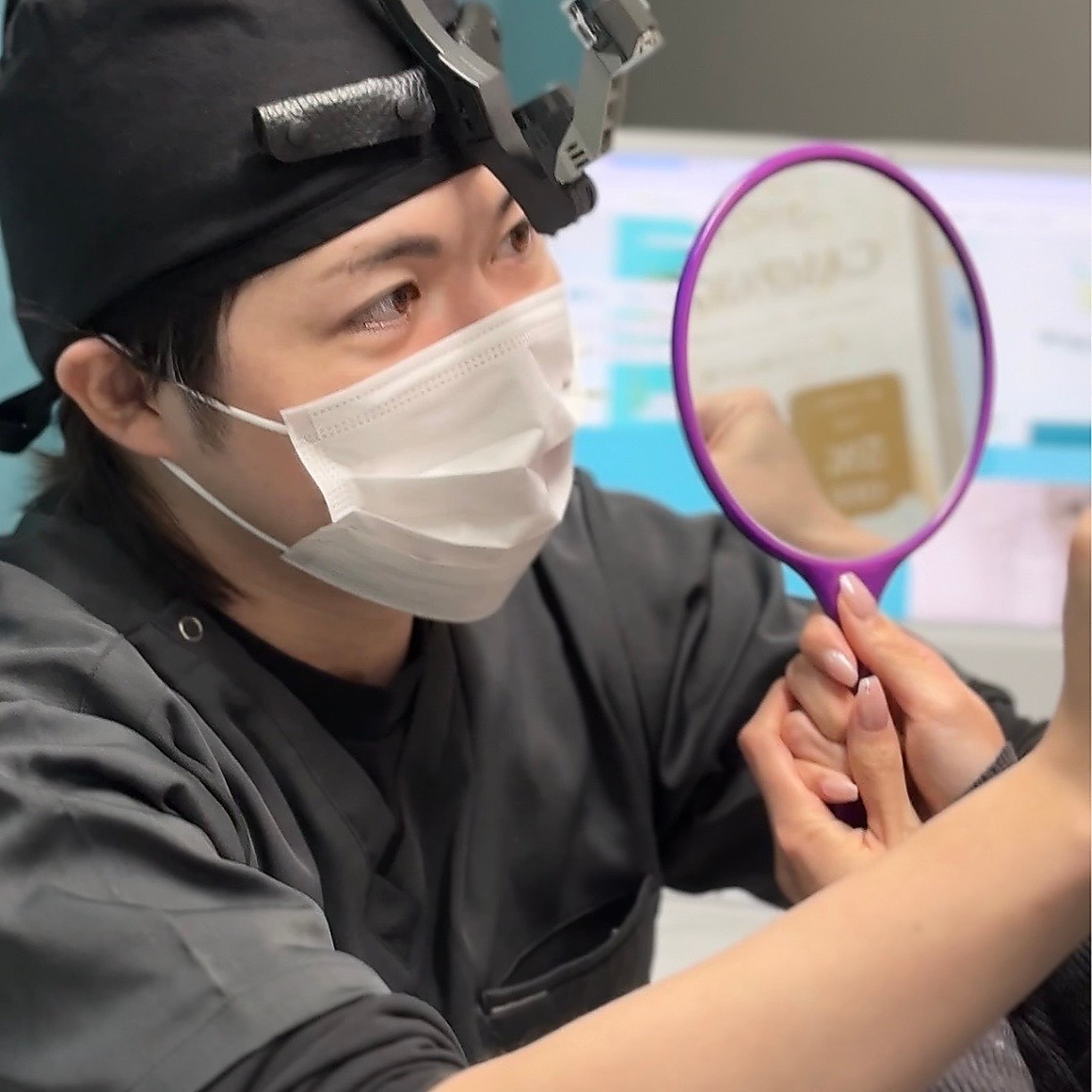
Looking in a mirror, we simulate your desired double eyelid width with a special tool. We examine the thickness of your eyelids and decide the fixation method and number of points together.
 STEP 02
- Treatment
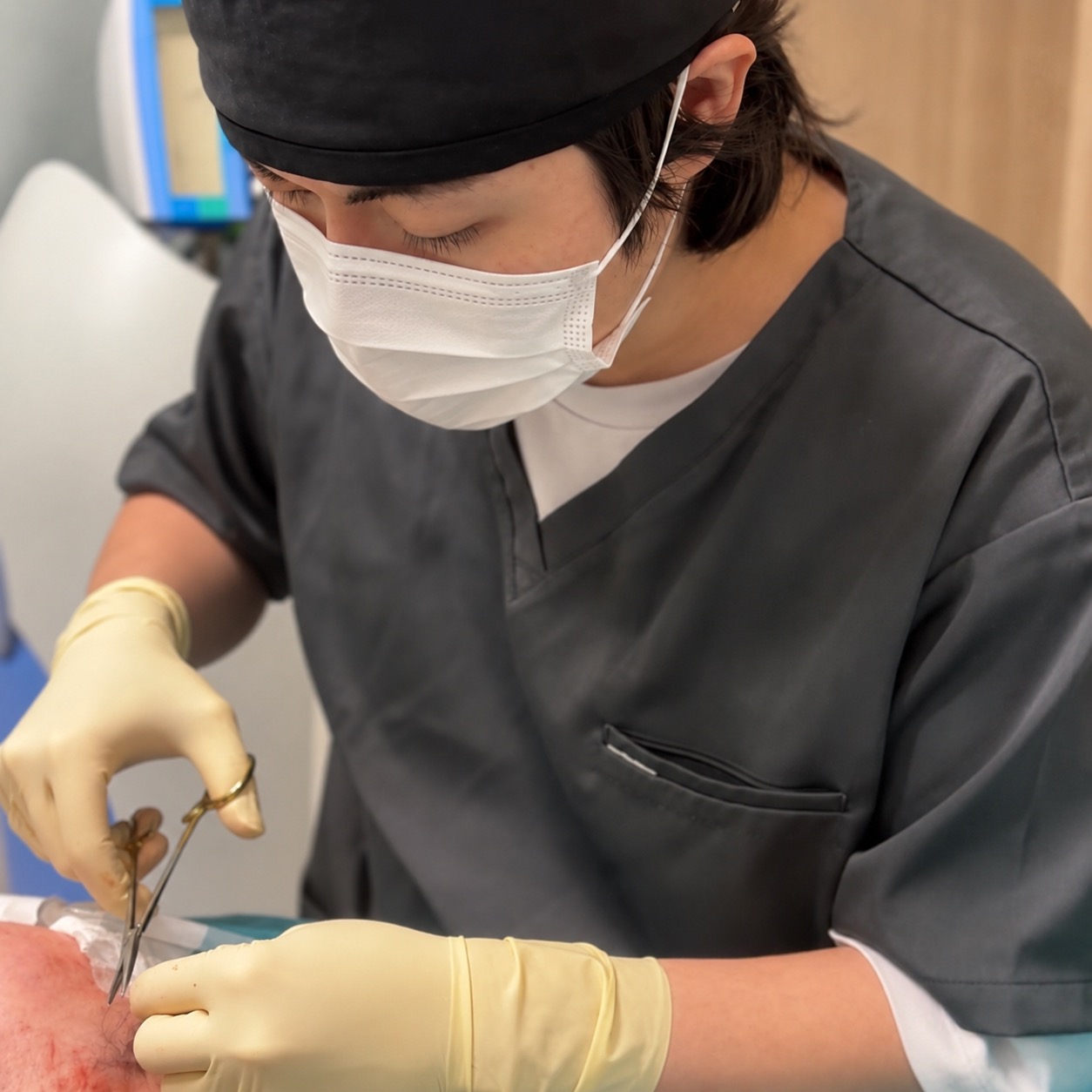
After local anesthesia with an ultra-fine needle (with nitrous oxide sedation on request), ultra-fine sutures are fixed using the chosen method to form the line. The excess suture is trimmed, the knot is buried, and asymmetry is checked while you sit up.
 STEP 03
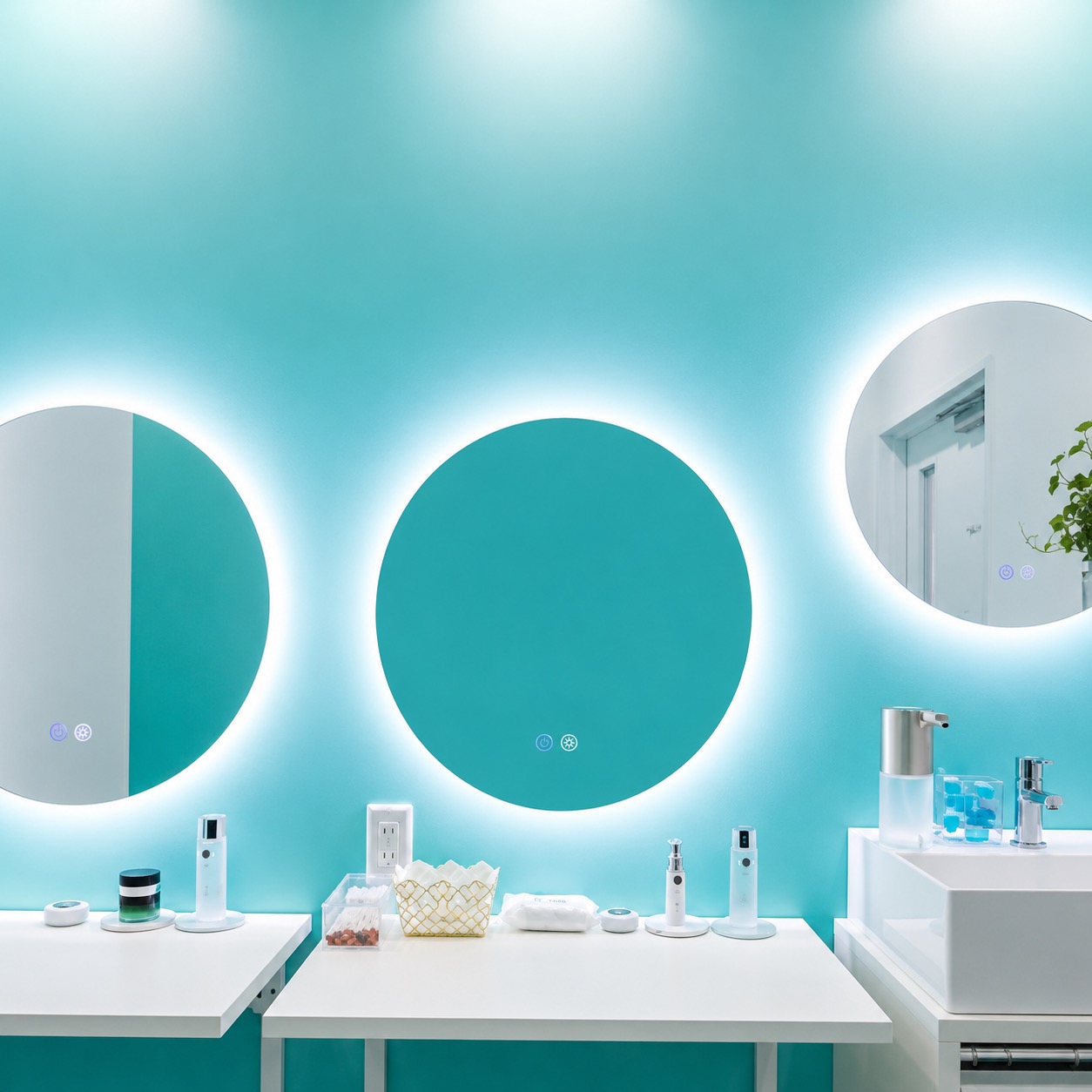
- Powder room
After we explain post-operative care and precautions, you go to the powder room, where we provide powder for touching up your makeup. You can get ready before going home.
PrecisionThe more fixation points,
the closer the line comes to the design
The double eyelid line is shaped by connecting the fixation points held by the suture. Because there is no support between points, the wider the spacing, the more easily the line strays from the designed curve, and the bigger the difference between your current eyelid and the ideal line, the more noticeable the deviation. The more fixation points, the easier it is to finely shape the line along the design.
- Designed line
- Actual line supported by the fixation points
- Fixation point (where the suture is fixed)
- Deviation from the design
2 points
Point fixation, 2 pointsWide spacing between points; easily strays from the design
Because 2 points support the whole line, it becomes straight between the points and at both ends, tending to be narrower than designed and tapered toward the inner corner. Depending on the condition of the eyelid and the ideal line, this number of points may be enough to hold the shape.
6 points
Point fixation, 6 points / natural adhesion, 6 pointsFollows the curve; the difference is slight
With narrower spacing, the line follows the curve from the inner to the outer corner, making the designed line easier to reproduce.
12 points
Secret Double, 12 pointsAlmost overlaps the designed line
With dense fixation points, fine adjustments can be made at any position. The bigger the difference between your current eyelid and the ideal line, the more the number of points matters.
Deciding the number of points from the condition of the eyelid
The number of fixation points needed isn’t decided by the shape of the design alone.
After examining your current condition—eyelid thickness, the epicanthal fold, fat, and skin laxity—we decide what will bring you closest to the line you want.
Even with the same eyelid condition, the best combination changes with what you prioritize.
We decide together at your examination, including the fact that more points spread the force and make loosening less likely.
* The illustrations are schematic diagrams showing how the line is designed. The actual position and number of fixation points and the result vary with the condition of the eyelid and your wishes, and differ between individuals. Because more points tend to mean slightly more downtime, we will propose the best combination after an examination.
CombinationFactors that hinder double eyelids,
Combination treatments
The result and durability of the buried suture method depend greatly on the condition of the eyelid: the epicanthal fold, orbital fat, and skin laxity. When these are pronounced, combining a treatment that addresses the cause itself, rather than forcing support with the method or number of points alone, helps stabilize the double eyelid line. At Wing clinic, we examine the condition of your eyelids and, when needed, suggest combining the following treatments.
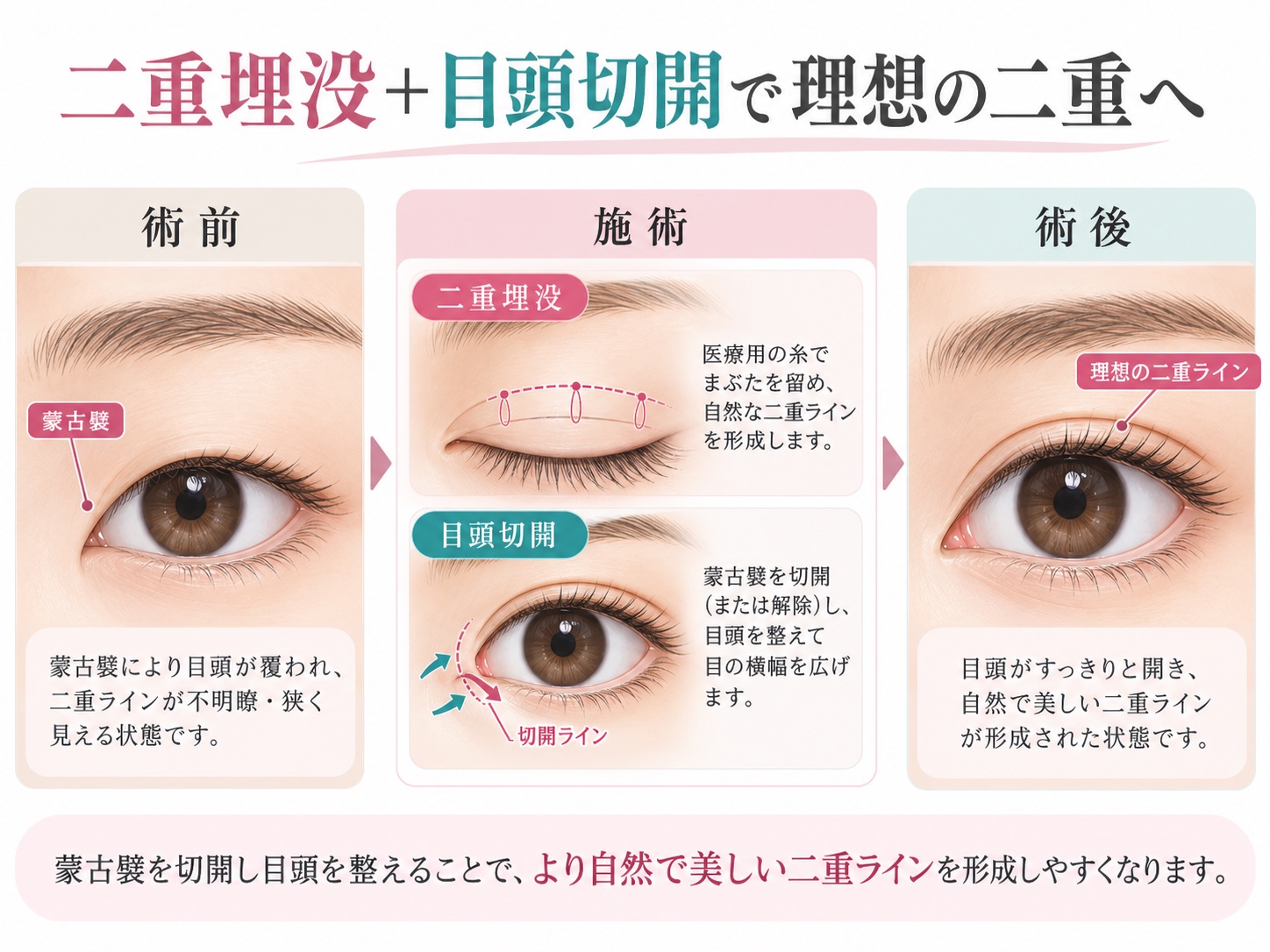
For a tight epicanthal foldInner canthoplasty
The epicanthal fold, a fold of skin covering the inner corner of the eye, pulls the double eyelid line down along with the muscles around the eye. If it is tight, the line held by buried sutures tends to come undone from the inner corner, and the line may be hidden at the inner corner. Treating the epicanthal fold with inner canthoplasty weakens the force pulling on the line, helping the double eyelid stabilize.
- Weakens the epicanthal fold’s pull on the line.
- Creates a foundation for double eyelids that don’t come undone easily from the inner corner.
- The line at the inner corner is less likely to be hidden.
- Downtime can be combined by doing it at the same time as the buried suture method.
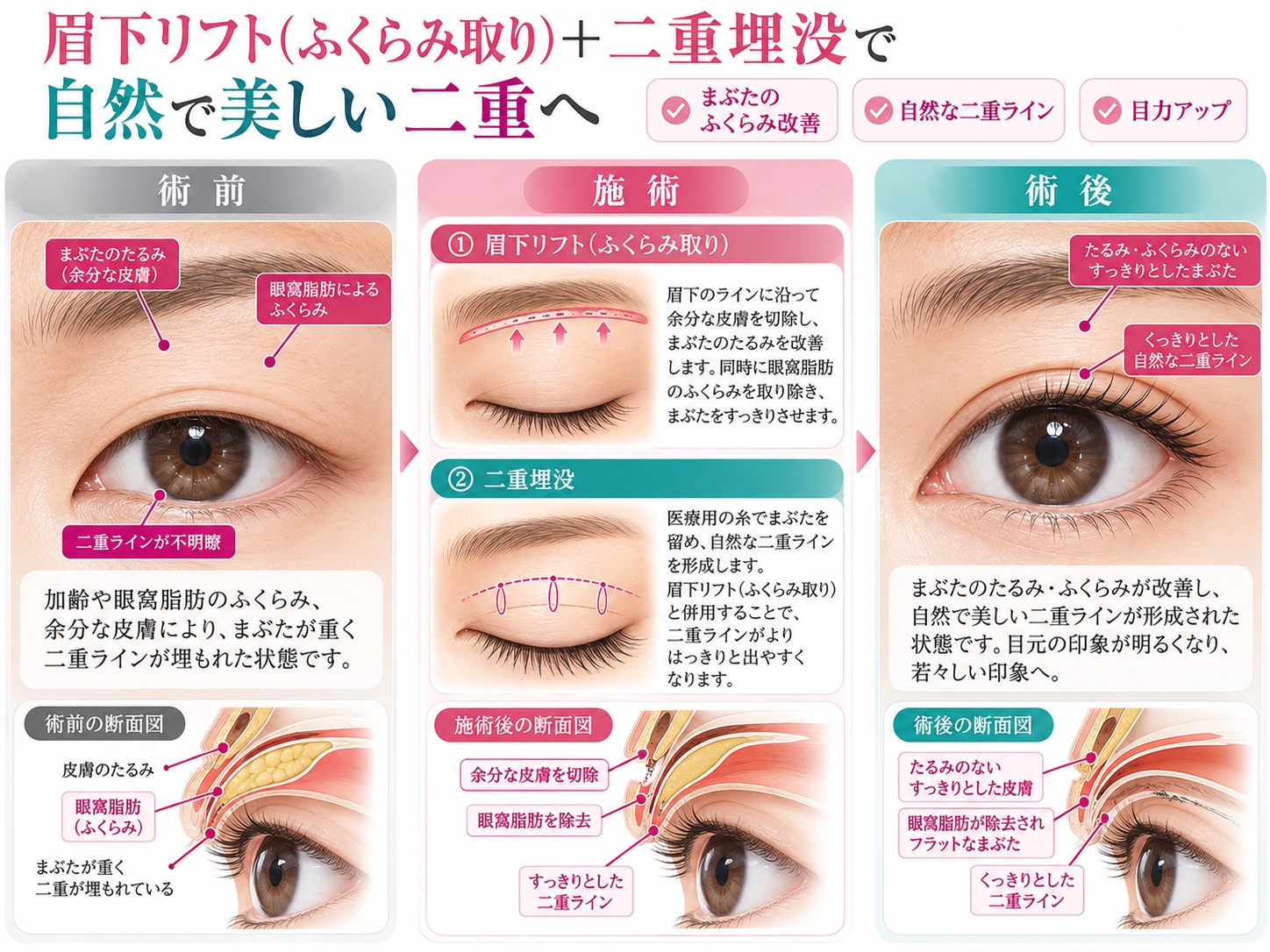
For thick, heavy eyelidsSub-brow lift and upper eyelid fat removal
If there is a lot of "orbital fat" deep in the eyelid, or the skin has stretched from long-term use of eyelid glue or with age, the eyelid becomes thick and heavy and the strain on the suture increases. Fat repeatedly swells and shrinks with puffiness, and stretched skin hangs over the line, making double eyelids shallower or looser.
Removing excess skin with a sub-brow incision to lift sagging, and removing excess upper eyelid fat at the same time, makes the eyelid lighter and creates a foundation on which the buried-suture line stabilizes more easily. The sub-brow scar is easily hidden along the eyebrow line, and the lash side isn’t cut. Because one or the other alone may be enough, we examine the condition of your eyelids and suggest the procedures needed.
- Reduces strain on the suture so it loosens less easily.
- Softens the thickness, heaviness, and overhang of the eyelid.
- The double eyelid line appears more clearly.
- The sub-brow scar is easily hidden under the eyebrow.
* Whether combinations are possible, which ones, and the prices are proposed during your consultation after examining your eye area. The same treatment is not suitable for everyone.
AnesthesiaAbout anesthesia
Buried-suture double eyelid surgery is performed under local anesthesia. For those who are very nervous, nitrous oxide sedation is also available.
-
01
- Local anesthesia (injection)
-
Anesthetic is injected into the eyelid to eliminate pain during the procedure. An ultra-fine needle is used to minimize the sting of the injection.
- You are conscious during treatment and will still feel touch
- Dull pain after the anesthetic wears off is managed with painkillers
- Price: included in the treatment price
-
02
- Nitrous oxide sedation
-
You inhale an odorless gas to relax. It eases tension while you stay conscious, and places little burden on the body.
- Works right after inhaling and wears off quickly once stopped
- For those who "just want to ease their nerves"
- Price: 5,500 yen
* Whether anesthesia is needed and which combination to use are proposed according to the condition of your eyelids and your wishes.
* IV sedation is not available for buried-suture double eyelid surgery or inner canthoplasty (among eye-area treatments, IV sedation is available only for under-eye bag removal and fat grafting).
Commitment3 Commitments at Wing clinic
A wide fold isn’t the goal.
We carefully design double eyelids that harmonize with each person’s eyes.
Width designed around "what suits you"
Rather than applying a trendy width as is, we use simulation to propose a double eyelid width that suits you, based on eyelid thickness, eye shape, and your wishes.
An unreasonably wide fold causes digging in, an unnatural look, and loosening. We decide together on a line that will still look natural 10 years from now.
We don’t push a fixation method
Point fixation, natural adhesion, and Secret each have their own merits, costs, and suitability.
We don’t recommend expensive plans across the board; we make honest recommendations based on the condition of your eyelids, your budget, and your wishes.
Your informed choice comes first.
Careful attention, down to asymmetry
A difference of a few millimeters changes how double eyelids look. During the procedure, we check repeatedly while you sit up and finely adjust left-right balance and the height of the line.
We also follow your recovery and provide support within the guarantee period, so you can consult us with peace of mind.
DoctorOur Doctors
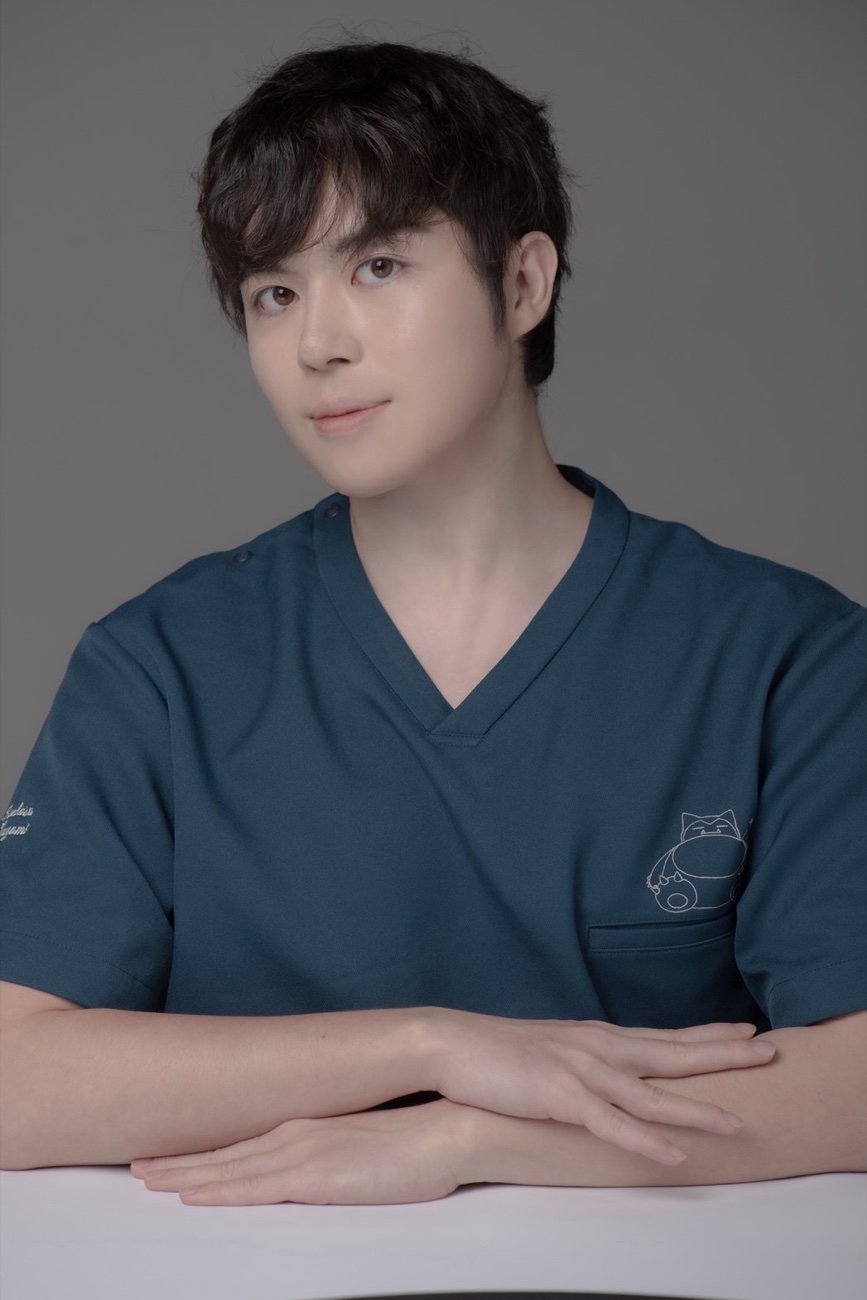
DirectorDr. Tsubasa Hayami, Clinic Director
A cosmetic surgeon who provides refined body contouring and facial slimming based on careful design and medical evidence. Drawing on his experience in ophthalmology, he designs natural double eyelids that suit you for years, with the condition of your eyelids and bone structure in mind.
— Specialties: facial liposuction / slim-face design / facial contouring / injectables / upper arm and leg liposuction
- Graduated from Kanazawa Medical University
- Department of Ophthalmology, Juntendo University
- Director, Tennoji branch of a major cosmetic surgery clinic
- Wing clinic Toyonaka opens
- Botox Vista / Juvéderm Vista certified doctor
- Alma Tune Lifting certified physician
- Onda Lift Kansai training physician / Oligio Kiss certified physician
- Facial liposuction: 1,000+ cases (Apr 2023 – Oct 2026)
PricePrices
All prices include tax.
Model prices require that you agree to the use of case photos on social media, etc.
METHOD 01Point fixation (standard buried suture)
METHOD 02Natural adhesion method
METHOD 03Secret method (inside fixation, lifetime guarantee)
OPTIONAnesthesia options
OPTIONSuture removal
OPTIONDoctor request fee
* All treatments shown are self-pay (not covered by insurance; paid in full by the patient). Prices include tax.
* Model prices are for patients who agree to have their case published in photos, on social media, etc. Contracts at model prices are not covered by the guarantee.
* If combination treatments or options are added, the total will be presented during your consultation.
* The guarantee covers re-treatment if the sutures come undone and the double eyelid disappears within the guarantee period. Detailed conditions are explained during your consultation.
* Prices include: consultation (free) / local anesthesia / post-operative follow-up (progress consultations and check-ups) / aftercare
* Medical loans and installment plans are available. We will simulate your monthly payments during your consultation, so feel free to ask.
* How results are felt varies by individual.
CasesCases
-
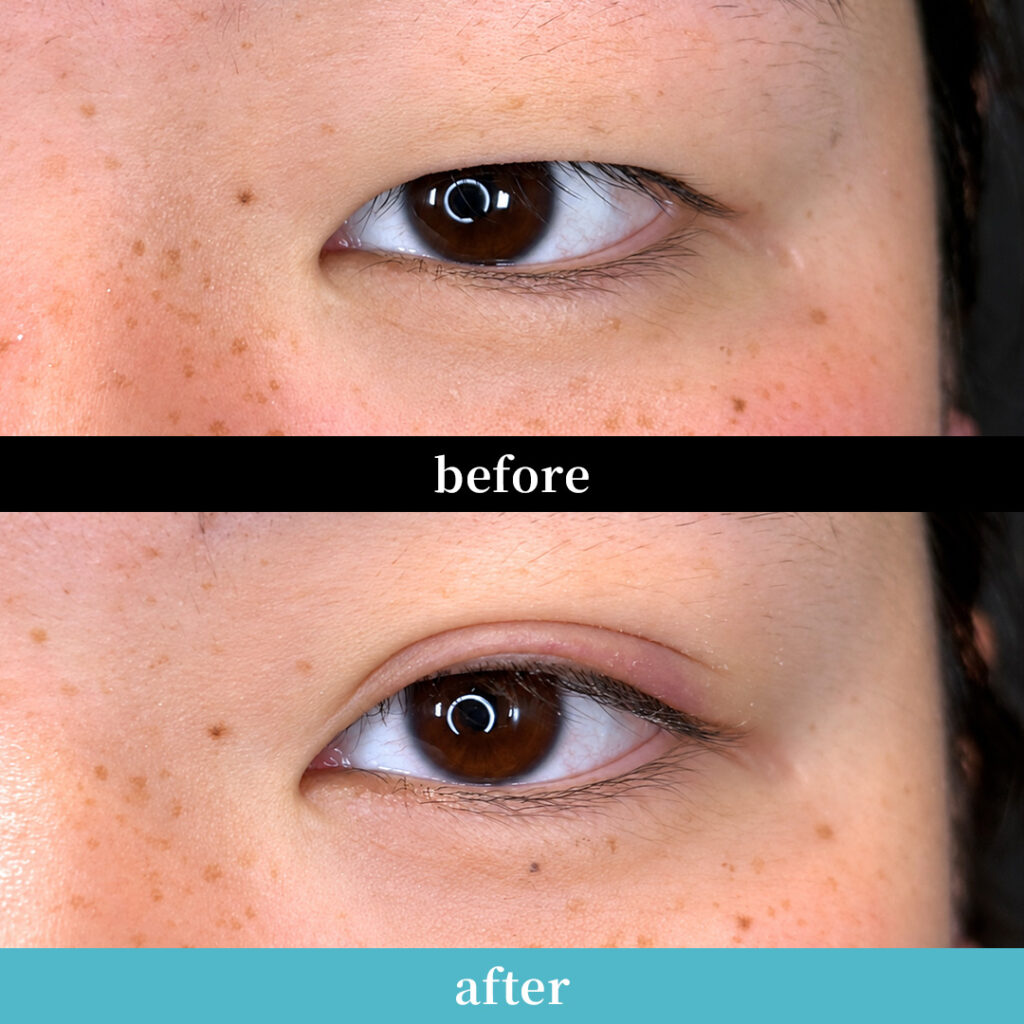
- Upper Eyelid Fat Removal (Female, teens, 2025.12)
- Treatment
- Upper eyelid fat removal, double eyelid surgery (buried suture)
- Price (incl. tax)
- 155,300 yen and up360,000 yen (regular price)
- Risks and side effects
- Swelling, bruising (may last about 2 weeks in particular), redness, tenderness, lumps in the skin, temporary pigmentation (post-inflammatory hyperpigmentation), infection (rare, but antibiotics may be needed), residual uneven raised areas or indentations, nerve damage or altered sensation (extremely rare), scarring or keloids (depending on your constitution)
- View case details
-
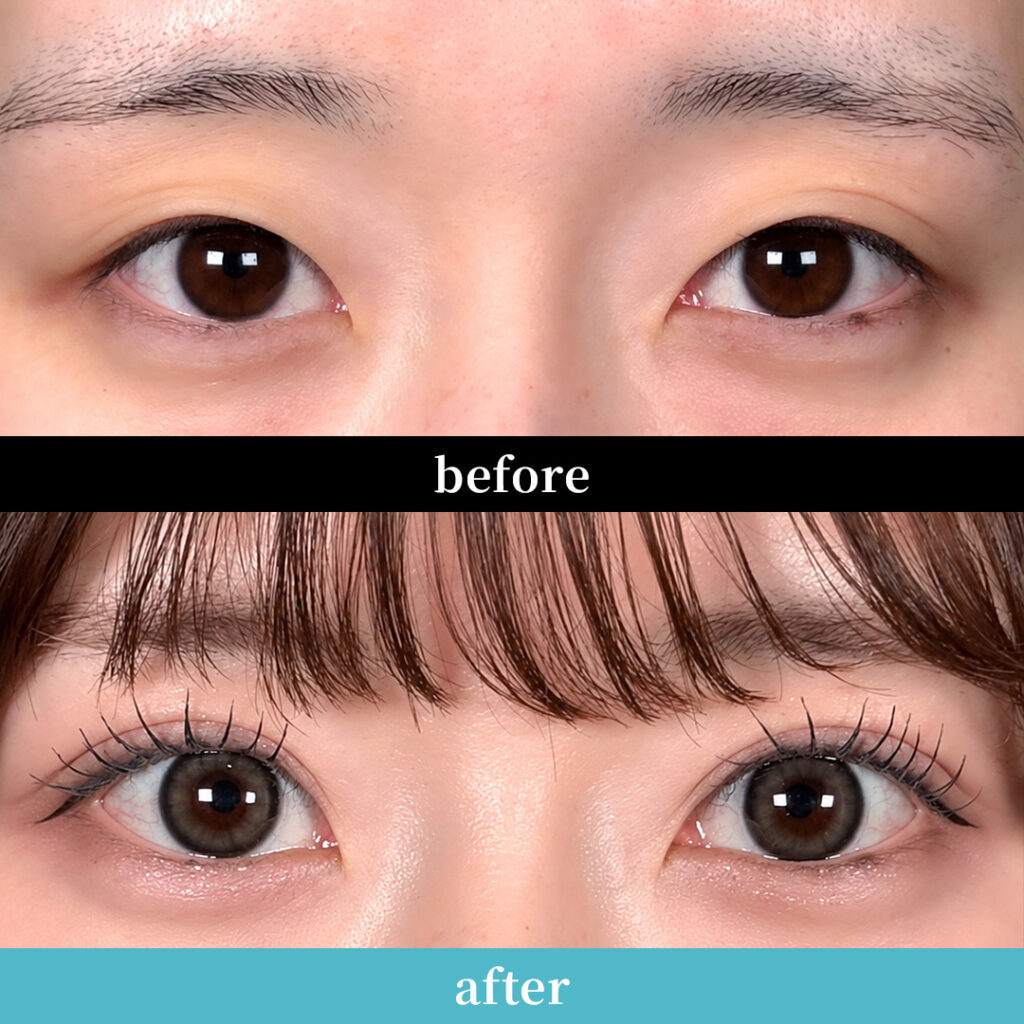
- Double Eyelid Surgery (Buried Suture, Natural Adhesion Method) (Female, 2026.05)
- Treatment
- Natural adhesion method, 6-point fixation (with nitrous oxide sedation)
- Price (incl. tax)
- 170000 yen and up290000 yen (regular price)
- Risks and side effects
- Visible scarring, asymmetry, thickened scars or keloids, dissatisfaction with the line or result, risk of eyelid drooping (ptosis)
- View case details
* These treatments are self-pay (not covered by insurance). Results vary by individual, and treatment involves downtime such as swelling and bruising.
FlowOn the day of treatment
About 1–2 hours from arrival to going home. You can go home the same day.
- 01approx.10 min
- Arrival and check-in
You will fill out a medical questionnaire. On the day, please come without eye makeup and be ready to remove contact lenses.
- 02approx.60 to 90 min
- Consultation and design
We simulate your desired double eyelid width with a special tool, examine the thickness of your eyelids, and decide the fixation method and number of points together. We also clearly explain prices and risks.
- 03approx.10 min
- Anesthesia
Local anesthesia (injection) is given with an ultra-fine needle. If you are very nervous, nitrous oxide sedation can be added.
- 04approx.15–30 min
- Buried suture procedure
Ultra-fine sutures are fixed using the chosen method to form the line. We finish while checking asymmetry with you sitting up.
- 05approx.15–30 min
- Cooling and rest
You rest in the clinic while cooling the area. We keep swelling down and check how you are feeling.
- 06Same-day discharge
- Going home and aftercare
You go home the same day with instructions and medication. We continue to support you with consultations and guarantee coverage.
* Times are approximate and may vary depending on the day, so please allow plenty of time.
DowntimeDowntime timeline
Downtime for the buried suture method is shorter than for incision methods. Swelling subsides as shown in the graph below.
* This course does not apply equally to everyone.
Guide to swelling and puffiness (relative image, with the post-surgery peak as 100)
Cooling
Peak
usually settle
discoloration fades
begins to settle
stabilize
Complete
★ Back to normal life: strong swelling settles in about 1 week for most people. It can often be covered with makeup.
-
- Swelling peaksDAYS 1–3
A period when swelling and bruising of the eyelids are likely. Cooling and rest keep them to a minimum. Swelling may look as if you’ve been crying, but it is temporary.
-
- Settling phaseWEEK 1–2
Strong swelling subsides, and for many people it can be covered with makeup. Any bruising turns yellow as it fades. The double eyelid width still looks a little wide.
-
- Blending phaseMONTH 1
Puffiness clears and the double eyelid line settles in. The slightly wide width right after the procedure gradually settles into a natural width.
-
- Completion phaseMONTH 2–3
Width and shape stabilize, completing natural double eyelids. Any digging in softens, and many people feel the result looks natural.
* The course, duration, and degree vary by individual. They also vary with eyelid thickness, fixation method, and number of points. Please contact us at any time about symptoms that concern you.
RiskRisks and how we handle them
Every treatment carries risks. Most can be avoided or reduced with understanding beforehand and appropriate care.
- 01
- Swelling and bruising
A physiological reaction in the first few days after treatment. Reduced with cooling and rest; most settle in 1–2 weeks.
- 02
- Double eyelids coming undone or loosening
If the suture fixation loosens, the double eyelid may become shallower. Within the guarantee period, we respond with re-treatment (for contracts at the regular price).
- 03
- Asymmetry
May arise from pre-existing differences in the eyelids. Minimized by pre-operative design and checks during the procedure.
- 04
- Exposed suture or discomfort
Rarely, the suture may show through or feel gritty. This is less likely with the Secret method.
- 05
- Difference from the expected width or shape
The width narrows as puffiness clears. We design with the final result in mind.
- 06
- Infection (extremely rare)
Sterile technique and oral medication as needed keep the incidence extremely low.
- 07
- Digging in or indentation
This tends to occur when a wide fold is created on a thick eyelid, so we design an appropriate width.
- 08
- Anesthesia-related risks
Anesthetics may cause changes in how you feel. We check your medical history and allergies in detail before treatment.
Who cannot have this treatment
- People who are pregnant or breastfeeding
- People with serious chronic illness or who take anticoagulants
- People with serious heart disease, diabetes, or systemic muscle disease
- People with inflammation or wounds in the treatment area
- People who have had or plan to have a vaccination within 2 weeks
Precautions
- If you have had a cosmetic treatment at another clinic within the past month, please tell us in advance.
- If you have ever had an allergic reaction to anesthetics or medication, please tell us in advance.
- If you take blood thinners (such as anticoagulants), the risk of bruising may be higher.
FAQFAQ
QWill buried sutures come undone?
Durability varies with the number of fixation points and the fixation method. The more points, and the more the method fixes along a line (natural adhesion) or on the inside (Secret), the less it tends to loosen. Each plan at the regular price comes with a guarantee period, and we provide support if it comes undone within that period (model prices are not covered by the guarantee).
QHow do point fixation, the natural adhesion method, and Secret differ?
Point fixation is the basic buried suture method that holds at several points and is easy to start with. The natural adhesion method creates adhesion along a line rather than at points, aiming for a more natural line that loosens less easily. The Secret method fixes the suture on the inside of the eyelid, so knots are unlikely to remain on the outside.
QHow long is the downtime?
Swelling peaks 2–3 days after treatment, and strong swelling settles in about 1 week for most people. It usually takes 1–3 months to fully settle. Any bruising can often be covered with makeup.
QCan I get double eyelids without anyone noticing?
The Secret method (inside fixation) creates no knots or wounds on the outside, so the knot is unlikely to show through and puffiness is easier to avoid. Swelling during downtime varies by individual, so please discuss timing with us around your schedule.
QHow many fixation points should I choose?
The right number of points depends on eyelid thickness, skin laxity, and the double eyelid width you want. Thicker eyelids often suit more points or the natural adhesion method. During your consultation, we examine your eyelids and propose the best plan.
QDoes the anesthesia hurt?
Pain during the procedure is eliminated with local anesthesia (injection). An ultra-fine needle is used to minimize the sting of the injection. For those who are very nervous, nitrous oxide sedation is also available. We combine options according to your level of pain and anxiety so that the procedure is as comfortable as possible.
QWhen can I resume makeup and contact lenses?
Makeup other than around the eyes is often possible from the same day, and eye makeup from a few days later. For contact lenses, we’ll advise from the next day onward depending on swelling. Details are given after the procedure.
QWhat does the guarantee cover?
Each plan has a guarantee period (e.g., 2-point fixation: 1 year, natural adhesion 4-point: 5 years, Secret: lifetime). It covers re-treatment if the sutures come undone and the double eyelid disappears within the guarantee period. The guarantee applies to contracts at the regular price (model prices are not covered). Detailed conditions are explained during your consultation.
Contact us Booking & Inquiries
You can also book or ask questions via LINE!
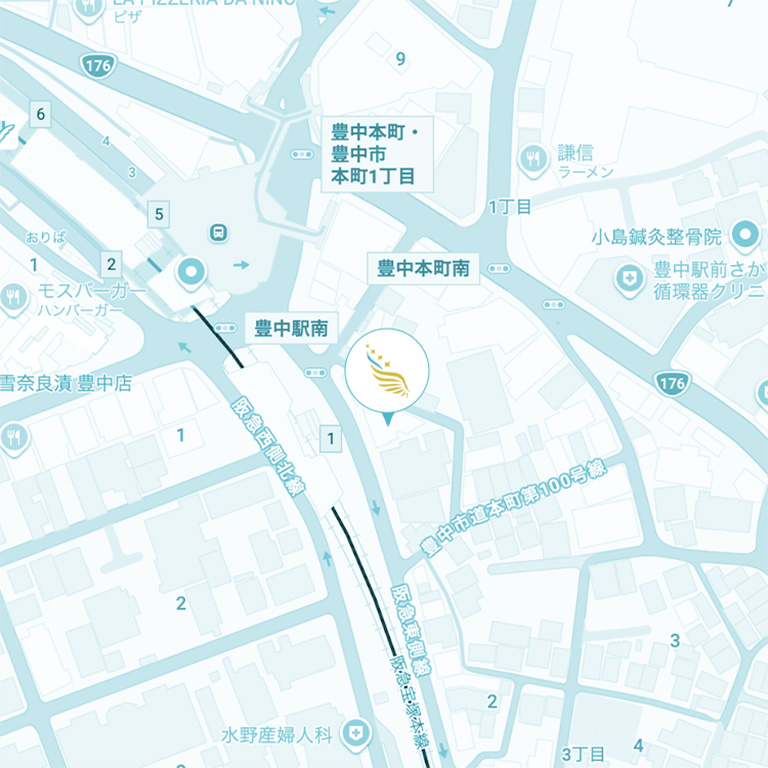
Access
View on a larger map4F Toyonaka Ekimae Yasuda Building, 1-2-35 Honmachi, Toyonaka, Osaka
- 1 minute walk from Hankyu Toyonaka Station / 11 minutes by train from Umeda Station
- 15 minutes from Itami Airport / 15 minutes from Shin-Osaka Station
Hours
10:00–20:00 (last entry 19:00)
Closed: irregular *For more information, please contact us.
Departments: Cosmetic Dermatology, Cosmetic Surgery, Internal Medicine, Dermatology